Momo Rare Books
Geneva 1615 New Testament and Apocrypha, W/ Map and Inscriptions
Geneva 1615 New Testament and Apocrypha, W/ Map and Inscriptions
Couldn't load pickup availability
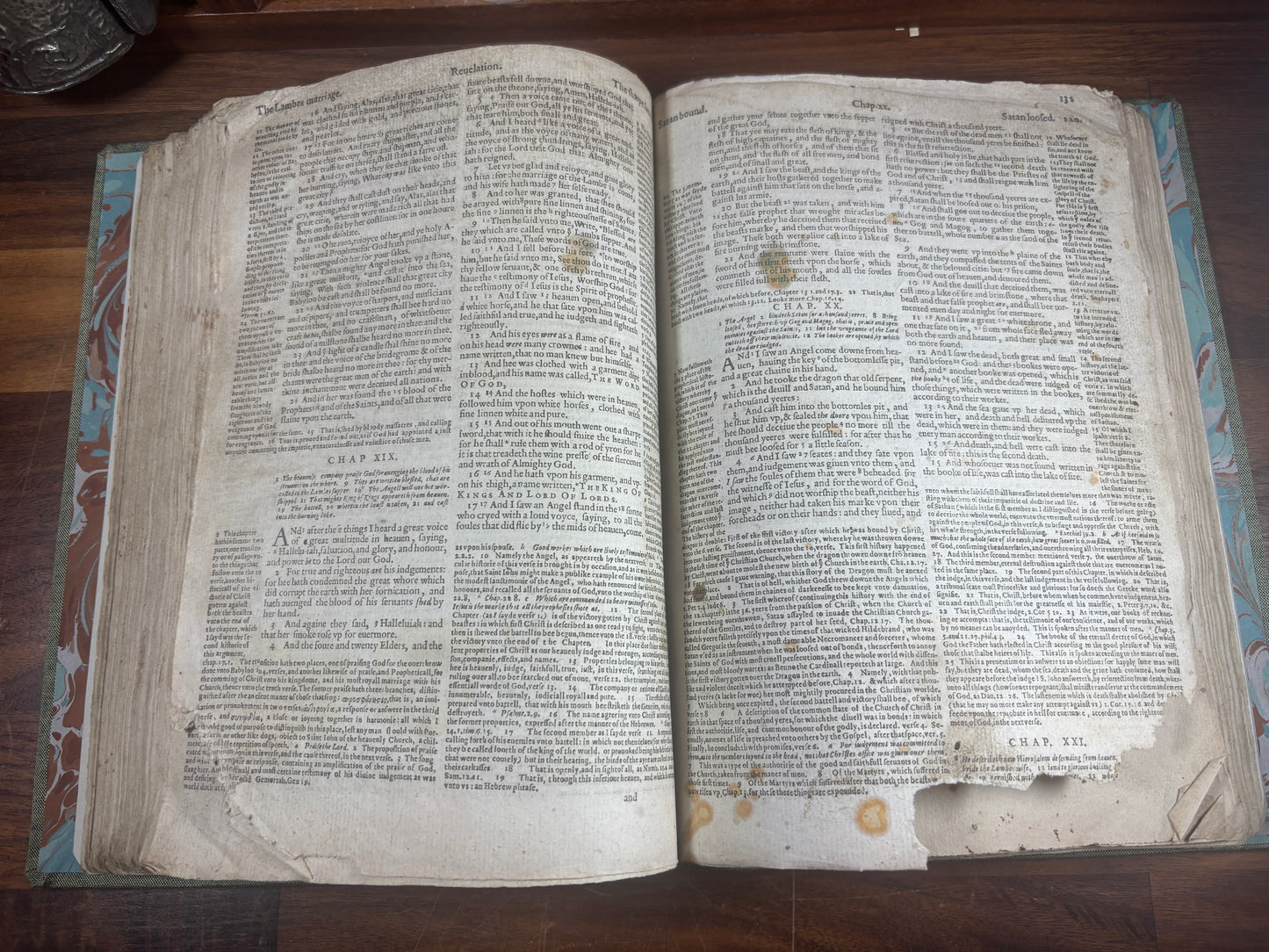
Offered here is an early and remarkably well-preserved Geneva New Testament, printed in London in 1615 by Robert Barker, the King's Printer under James I. This edition contains the complete New Testament together with the complete Apocrypha, surviving in a later twentieth-century preservation binding.
Although the Old Testament is no longer present, the surviving portion is unusually substantial. The volume retains its beautiful engraved architectural title page, extensive marginal annotations derived from Theodore Beza and Franciscus Junius, the engraved map of the Holy Land, the chronological table entitled "The Order of Time," and the celebrated commentary on the Book of Revelation that helped make the Geneva Bible one of the most influential English Bibles ever printed.
Printed only four years after the publication of the first King James Bible, this volume represents a fascinating period when the Geneva Bible still enjoyed enormous popularity despite royal efforts to promote the new Authorized Version.
Bibliographical Description
The New Testament of Our Lord Jesus Christ
Translated out of Greek by Theodore Beza, English translation by Laurence Tomson, with Beza's annotations and the commentary of Franciscus Junius upon the Revelation.
Printed at London by Robert Barker, Printer to the King's Most Excellent Majesty.
1615.
Contents
The volume includes:
- Engraved New Testament title page
- Printer's Preface
- Complete New Testament
- Complete Apocrypha beginning with 1 Esdras
- Engraved Holy Land map
- "The Order of Time" chronological table
- Revelation with Geneva commentary
The Apocrypha has been bound after the New Testament during a later rebinding. While this is not its original position in a complete Geneva Bible, it preserves what appears to be the surviving Apocryphal section alongside the New Testament.
Condition
Modern green cloth preservation binding with printed paper title label to the upper board.
The text is generally clean and highly legible throughout, with attractive dark impressions.
Condition includes:
- Complete engraved title page.
- Complete New Testament, with the exception of several missing leaves from the Book of Revelation.
- Complete Apocrypha beginning with 1 Esdras.
- Engraved Holy Land map present.
- "The Order of Time" present.
- Contemporary ownership inscriptions, pen trials, and manuscript doodles on several preliminary leaves.
- Occasional staining and foxing.
- Some marginal repairs, folded corners, and edge wear.
- Small areas of worming.
- Marginal loss to a small number of leaves, largely avoiding the printed text.
- Modern cloth rebinding preserving the surviving text block.
Overall, this is an attractive and well-preserved survival of one of the most important English Bible translations of the early seventeenth century.
Historical Background
The Geneva Bible first appeared in 1560, produced by English Protestant scholars who had fled to Geneva during the reign of Mary I. It quickly became the Bible of English-speaking Protestants and remained so for over half a century.
Its popularity rested upon several innovations:
- extensive explanatory notes;
- clear Roman type;
- numbered verses;
- maps and illustrations;
- practical cross-references;
- readable English translation.
The Geneva Bible was the Bible of Shakespeare, the Pilgrims aboard the Mayflower, Oliver Cromwell, and countless English households.
England in 1615
This New Testament was printed during the reign of King James I, only four years after the publication of the KJV in 1611.
Despite the King's sponsorship of the new translation, the Geneva Bible remained immensely popular. Many readers preferred its familiar text and, especially, its extensive marginal notes. Robert Barker, the King's own printer, therefore continued producing Geneva editions alongside the Authorized Version for several years.
The early seventeenth century was a period of intense religious debate. Questions surrounding royal authority, biblical interpretation, and church governance would eventually contribute to the political and religious conflicts that culminated in the English Civil War only a few decades later.
Volumes such as this illustrate the continued demand for the Geneva tradition during this transitional period of English printing.
The Geneva Annotations
Perhaps no feature distinguishes the Geneva Bible more than its marginal notes.
Prepared principally by Theodore Beza and other leading Protestant scholars, these annotations offered theological commentary, historical explanation, cross-references, and practical guidance for readers. Their distinctly Reformed perspective made the Geneva Bible enormously influential, but also controversial.
King James I is widely believed to have objected to several of these notes because they occasionally questioned the conduct of rulers and magistrates. This dissatisfaction was one factor behind the commissioning of the Authorized Version in 1604.
The notes found throughout this volume remain among the defining characteristics of the Geneva Bible and represent one of the earliest and most successful examples of an annotated English Bible.
Provenance
The volume contains numerous early manuscript pen trials, ownership inscriptions, and doodles on the preliminary leaves, providing tangible evidence of centuries of ownership and use. While many are difficult to decipher, they form part of the book's long history and testify to its continued use by successive readers rather than its preservation as a mere display object.
Dimensions:
Weight - 585g
Height - 23cm
Width - 17.2cm
Thickness - 3cm
Share