Momo Rare Books
French Book of Hours Dated 1619, The Council of Trent Era, Morocco Binding
French Book of Hours Dated 1619, The Council of Trent Era, Morocco Binding
Couldn't load pickup availability
A beautiful and authentic French Book of Hours, printed in Paris in 1619, containing the Office of the Blessed Virgin Mary for use throughout the liturgical year. Produced in the decades following the Council of Trent, this devotional work reflects the renewed emphasis on standardized Catholic worship during the Counter-Reformation.
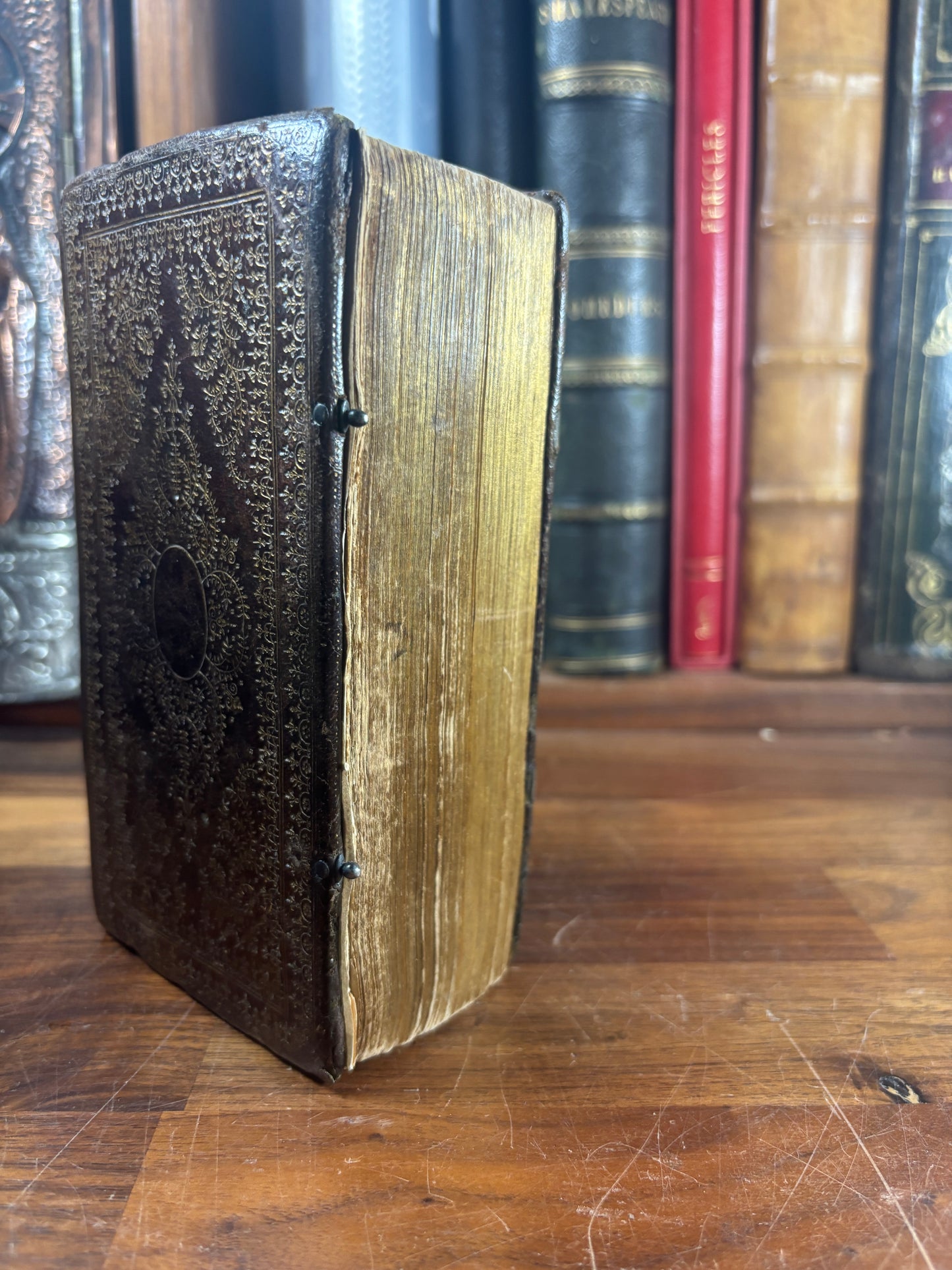
Measuring 16.5 x 9 cm, this elegant pocket-sized volume is bound in its original contemporary gilt brown morocco binding, retaining its finely executed pointillé decoration and original brass clasp hardware. Printed throughout in red and black, the volume is illustrated with a complete suite of finely engraved copperplate plates, including a richly illustrated calendar of saints, portraits of the Apostles, devotional scenes, and the Coronation of the Virgin.
The engraved title page has been supplied in facsimile, almost certainly replacing a missing original, a common occurrence in devotional books that saw centuries of daily use. The remainder of the text and engraved illustrations appear original and complete.
Features
-
Paris, 1619
-
Small octavo (16.5 × 9 cm)
-
Contemporary gilt brown morocco binding
-
Elaborate pointillé gilt decoration
-
Original brass clasp hardware retained
-
Printed in red and black throughout
-
Complete engraved calendar
-
Complete suite of copperplate engravings
-
Contemporary devotional text following the reforms of the Council of Trent
-
Engraved title page supplied in facsimile
-
Historic repairs to several leaves
-
Original text block and binding preserved
About the Book
Books of Hours were among the most cherished books of the late medieval and early modern periods. Intended for private devotion rather than public worship, they accompanied their owners through daily prayer and often became treasured family heirlooms.
This edition contains the Office of the Blessed Virgin Mary, together with prayers, calendars of saints, Gospel readings, and other liturgical texts used throughout the church year.
By the beginning of the seventeenth century, printed Books of Hours had largely replaced manuscript examples while preserving the same beauty and devotional purpose. Wealthier purchasers often commissioned deluxe bindings, making volumes such as this both religious objects and examples of fine craftsmanship.
The Council of Trent and the Catholic Reformation
This volume belongs to one of the most important periods in the history of the Roman Catholic Church.
The Council of Trent was convened in response to the Protestant Reformation and became the defining council of the Catholic Counter-Reformation. Meeting over nearly twenty years, the council reaffirmed Catholic doctrine while introducing sweeping reforms intended to strengthen the Church and standardize religious practice.
Among its most significant achievements were:
-
Standardization of the Roman liturgy
-
Reform of the Missal and Breviary
-
Improved education and discipline of the clergy
-
Uniform devotional texts throughout the Catholic world
-
Renewed emphasis on personal prayer and sacramental life
Books of Hours printed after Trent were carefully revised to conform to these reforms. The title page of this edition proudly announces that it has been revised "according to the reform of the Council of Trent," placing it squarely within the movement that reshaped Catholic devotional life across Europe.
France in 1619
This book was printed during the reign of Louis XIII, only a generation after France emerged from the devastating Wars of Religion that had divided Catholics and Protestants throughout the sixteenth century.
Following the assassination of Henry IV in 1610, France entered a period of renewed political consolidation under the young Louis XIII. The Catholic Church, supported by both the monarchy and influential religious orders such as the Jesuits, encouraged renewed religious education, personal devotion, and the production of standardized devotional literature.
Paris became one of Europe's foremost centres of fine printing. The city's presses produced beautifully illustrated prayer books intended for educated laypeople, members of the clergy, and the growing Catholic middle class. This volume is representative of that flourishing period of French printing, when devotional books combined elegant typography, copperplate engraving, and luxurious bindings.
The Binding
One of the most remarkable aspects of this volume is its contemporary French gilt morocco binding, which survives largely intact after more than four centuries.
Bound in richly gilt brown morocco leather, the covers are decorated in the refined pointillé style that became fashionable in Paris during the late sixteenth and early seventeenth centuries. The decoration consists of numerous individually applied finishing tools creating intricate floral sprays, scrolling vines, delicate borders, and a large central oval cartouche intended for the addition of a coat of arms or owner's initials.
The spine is similarly decorated with gilt tooling, while the original brass clasp hardware remains attached, a feature frequently missing from surviving examples.
Although not attributable to one of the celebrated royal binders such as Clovis or Nicolas Ève, the binding belongs to the same artistic tradition that defined luxury Parisian bookbinding during the early reign of Louis XIII.
The Engravings
The volume contains a complete suite of finely executed copperplate engravings, including:
-
Monthly calendar illustrations depicting the Apostles
-
The Coronation of the Virgin
-
Gospel illustrations
-
Passion scenes
-
Decorative devotional imagery throughout the text
The impressions remain crisp and well inked, preserving the fine detail characteristic of early seventeenth-century copperplate engraving.
Condition
-
Original contemporary gilt morocco binding.
-
Complete engraved illustrations.
-
Original brass clasp hardware retained.
-
Printed throughout in red and black.
-
Historic repairs to several leaves.
-
Engraved title page supplied in facsimile.
-
Light age toning, occasional spotting, and expected evidence of devotional use.
-
Original text block remains structurally sound.
-
Facsimile title page
Historical Significance
This volume embodies the intersection of religion, art, and craftsmanship during one of Europe's most transformative periods.
Printed shortly after the implementation of the reforms of the Council of Trent, it illustrates how the Catholic Church sought to unify devotional practice while promoting beautiful, accessible prayer books for private use. At the same time, it represents the exceptional quality of Parisian printing and bookbinding during the early seventeenth century.
Books such as this were intended not merely to be read but to accompany their owners throughout life. Their survival in original bindings is increasingly uncommon, particularly when accompanied by complete engraved illustrations.
- Weight - 526g
- Height - 16.5cm
- Width - 9cm
- Thickness - 5cm
Share