Momo Rare Books
1795 Killer Bible, Thomas Bensley, Illustrated KJV, Three Volumes
1795 Killer Bible, Thomas Bensley, Illustrated KJV, Three Volumes
Couldn't load pickup availability
Overview:
- Title: The Holy Bible, Ornamented with Engravings from Celebrated Pictures by Old Masters
- Date: 1795
- Printer: Thomas Bensley, London
- Publisher: Robert Bowyer, London
- Engraver: James Fittler and others
- Translation: King James Version
- Edition: Bowyer-Fittler Bible, also known as the Cabinet Bible or Killer Bible
- Format: Three volumes
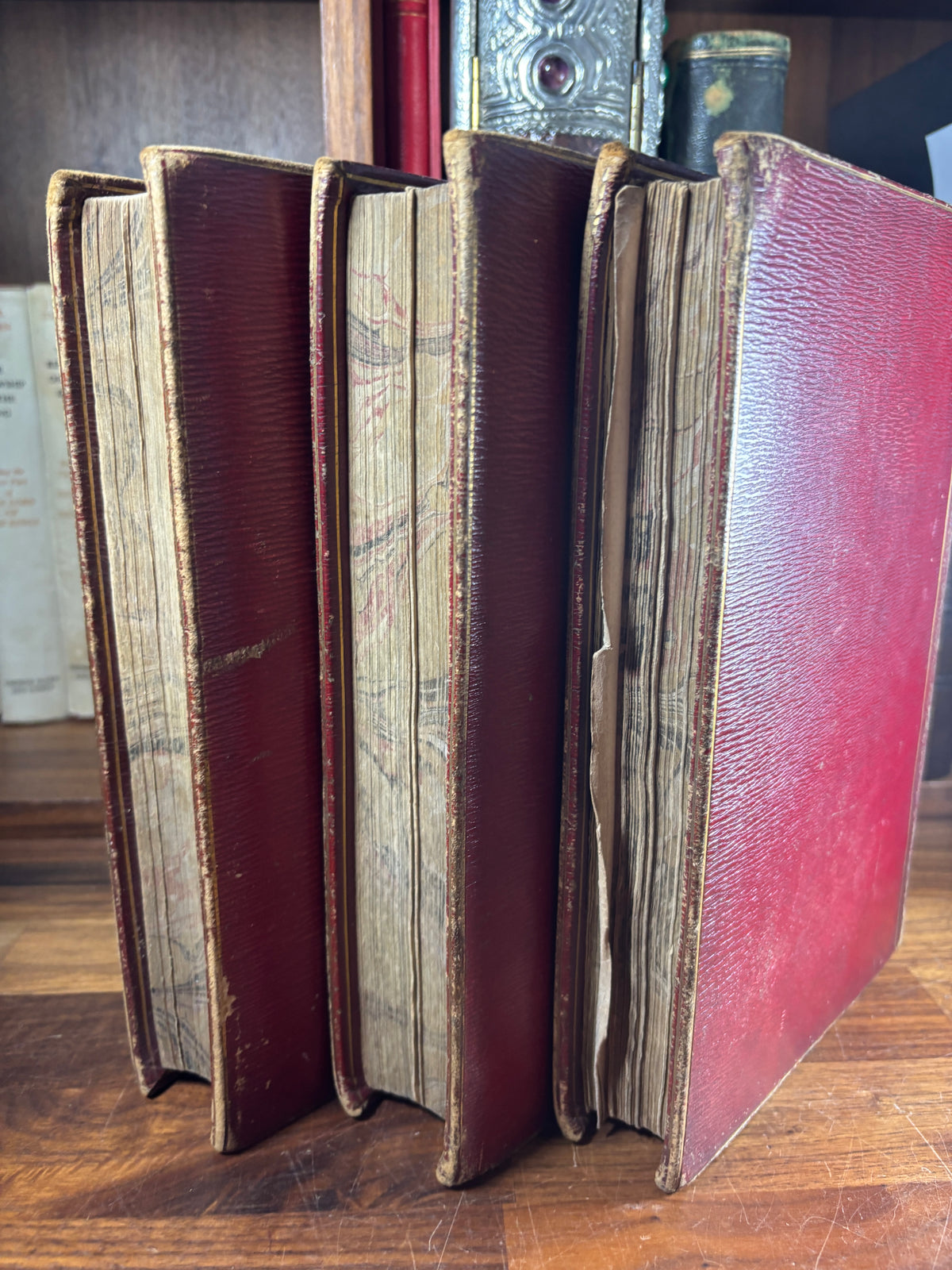
- Binding: Red straight-grain leather with gilt decoration and marbled page edges
- Bibliographical Reference: Herbert 1394
- Contains famous "They shall be killed"
An attractive and richly illustrated three-volume edition of the King James Bible, published in London in 1795 and printed by the celebrated Thomas Bensley.
Commonly known as the "Killer Bible", this edition contains one of the most notorious printing errors in the history of the English Bible. In Mark 7:27, the text mistakenly reads:
"Let the children first be killed"
Rather than the intended:
"Let the children first be filled"
This extraordinary typographical error has earned the edition its memorable nickname and made it a particularly interesting example of eighteenth-century biblical printing.
Beyond its famous misprint, the Bowyer-Fittler Bible is distinguished by its elaborate engravings after celebrated European Old Masters, decorative engraved titles, and illustrated contents pages.
The present example is bound in three matching volumes of red straight-grain leather, with gilt-decorated spines and marbled page edges. An early ownership inscription dated 1803 adds further historical interest.
An appealing addition to any collection of rare Bibles, eighteenth-century printing, or illustrated religious literature.
The Famous Killer Bible
The history of the English Bible is filled with remarkable printing errors, several of which became sufficiently notorious to give entire editions distinctive nicknames.
Among the best-known examples are the Wicked Bible of 1631, which omitted the word "not" from the Seventh Commandment, and the Vinegar Bible of 1717, which famously misprinted the heading of the Parable of the Vineyard.
The Killer Bible belongs to this unusual tradition.
Printed in 1795, the present edition contains the extraordinary substitution of "killed" for "filled" in Mark 7:27.
The verse records Christ's response to the Syrophoenician woman who sought healing for her daughter. The printing error dramatically alters the meaning of the passage, transforming a statement concerning the feeding of children into something considerably more sinister.
The error is clearly present in this copy and provides a fascinating illustration of the challenges associated with producing substantial printed works before modern proofreading and printing technologies.
The Bowyer-Fittler Bible
Published in London in 1795, the Bowyer-Fittler Bible represents an ambitious attempt to combine the traditional text of the King James Bible with the artistic accomplishments of European painting and engraving.
The publication was associated with Robert Bowyer, an important London publisher and print seller known for producing elaborate illustrated works.
The biblical text was printed by Thomas Bensley, one of the notable English printers of the late eighteenth and early nineteenth centuries.
James Fittler, an accomplished English engraver, contributed to the publication's extensive illustrative programme.
Unlike more conventional eighteenth-century Bibles, which often relied upon relatively simple decorative elements, this edition incorporated numerous engraved illustrations inspired by celebrated works of art.
The result was a Bible intended not merely for religious reading but also as a substantial artistic and literary publication.
Thomas Bensley and the Art of Printing
Thomas Bensley (1759–1835) was an important figure in the development of fine printing in Britain.
Working during a period of considerable advancement in English book production, Bensley became associated with numerous prestigious publications, including illustrated books and works requiring particularly careful typography.
His printing business was recognised for its technical capabilities and its involvement in the production of finely executed books.
The Bowyer-Fittler Bible is an example of this tradition, combining carefully arranged letterpress typography with elaborate engraved illustrations.
Its production reflects the growing market for luxurious illustrated publications among Britain's educated and affluent readers during the late Georgian period.
The Engravings
One of the most attractive features of this edition is its extensive use of copperplate engravings.
The illustrations reproduce biblical scenes inspired by the compositions of celebrated European artists, accompanied by decorative engraved contents pages.
Among the subjects illustrated in the present set are:
-
Adam and Eve in the Garden of Eden.
-
The Expulsion from Paradise.
-
Moses as an infant.
-
Jacob Wrestling with the Angel.
-
Scenes from the books of Genesis and Exodus.
-
Events from the life of Christ.
-
The Revelation of St John.
The engraved title pages feature elaborate calligraphic lettering, while the illustrated contents pages combine biblical scenes with finely executed decorative typography.
These engravings provide an excellent example of the artistic ambitions of late eighteenth-century biblical publishing.
Historical Context: Britain in 1795
This Bible was published during a particularly turbulent period in European history.
In 1795, Britain was engaged in the French Revolutionary Wars, as the political upheaval following the French Revolution continued to reshape Europe.
King George III occupied the British throne, while William Pitt the Younger served as Prime Minister.
The Industrial Revolution was transforming British manufacturing, commerce, and society, while improvements in printing and engraving were making increasingly elaborate publications possible.
Religious literature remained central to British intellectual and cultural life, and the King James Bible continued to occupy an important position in English-speaking Protestant society.
The Bowyer-Fittler Bible reflects this period of artistic and technological development, combining a traditional biblical text with the increasingly sophisticated methods of late Georgian book production.
Provenance
An early handwritten ownership inscription, dated 29 June 1803, is present.
The inscription appears to bear the surname Cornwallis, although the precise reading of the owner's name requires further verification.
This inscription demonstrates ownership of the Bible within approximately eight years of its stated publication date.
Condition and Binding
The Bible is presented in three matching volumes, bound in attractive red straight-grain leather.
The spines feature gilt lettering reading "BIBLE", decorative horizontal gilt rules, and gilt volume numbers.
The boards are finished with gilt borders, while the page edges retain decorative marbling.
The bindings exhibit age-related wear, including rubbing and scuffing to the leather, particularly along the spines, corners, and extremities. Areas of surface wear and loss of colour are visible.
The boards remain attractive overall, retaining much of their original decorative character.
Internally, the text is generally clean and legible, with occasional foxing, spotting, staining, and age-related discolouration.
Some engraved plates exhibit scattered foxing, while occasional leaves show minor creasing or edge wear.
There is some visible separation within the text block of the third volume.
The famous Killer Bible printing error is present in Mark 7:27.
An attractive and historically fascinating example of eighteenth-century English biblical printing, combining the notorious Killer Bible misprint with an elaborate programme of engravings and handsome period-style bindings.
Dimensions (Of all three):
Weight - 3.95kg
Height - 25cm
Width - 16.7cm
Thickness - 13.8cm
Share