Momo Rare Books
1728 Benedictine Monastic Breviary, Venice, Nicola Pezzana, with 1739 Florentine Supplements
1728 Benedictine Monastic Breviary, Venice, Nicola Pezzana, with 1739 Florentine Supplements
Couldn't load pickup availability
Title: Breviarium Monasticum, Pauli V. ac Urbani VIII. Summorum Pontificum Auctoritate Recognitum, pro Omnibus sub Regula SS. P. Benedicti Militantibus
Part: Pars Hiemalis
Printer: Nicola Pezzana
Place: Venice
Date: 1728
Language: Latin
Binding: Early leather over boards
Later material: Florentine liturgical supplements dated 1739
Description
An impressive early eighteenth-century Benedictine monastic breviary, printed in Venice by Nicola Pezzana in 1728. This substantial volume contains the Pars Hiemalis, or Winter portion, of the Divine Office for communities following the Rule of St Benedict.
The work is extensively printed in red and black, with red rubrics, feast headings and liturgical directions accompanying the main text. Arranged predominantly in double columns, it contains the prayers, psalms, antiphons, lessons, hymns and offices required for the Benedictine cycle of daily worship.
The title identifies the work as having been authorised under Popes Paul V and Urban VIII and intended pro omnibus sub Regula SS. P. Benedicti militantibus, essentially "for all those serving under the Rule of the Most Holy Father Benedict."
Nicola Pezzana and his family were established Venetian printers of religious and liturgical works. Pezzana continued to issue Roman breviaries and other ecclesiastical books well into the eighteenth century.
An Evolving Liturgical Book
Of particular interest are the later printed additions bound into this copy.
Among these is an office for St John of Nepomuk, whose canonisation occurred in 1729, one year after the original breviary was printed. Its presence therefore demonstrates that the volume continued to be used and updated after publication.
More significantly, the volume contains separately printed material bearing the imprint:
Florentiae, MDCCXXXIX
Ex Typographia Bernardi Paperini
Superiorum Permissu
This Florentine material dates to 1739, eleven years after the original Venetian printing, and includes references to Maria Theresa, Archduchess of Austria and Grand Duchess of Tuscany, together with additional offices including those of St John Nepomuk and the Archangel Raphael.
Rather than being discarded when the liturgical calendar developed, this expensive working breviary appears to have been kept current through the addition of newly authorised offices, providing an interesting physical record of eighteenth-century Catholic liturgical practice.
The Benedictine Divine Office
A breviary was not principally intended for celebration of the Mass, but for the Divine Office, the cycle of prayers traditionally recited throughout the day and night.
For Benedictine communities this formed a fundamental part of monastic life, governing Matins, Lauds, Prime, Terce, Sext, None, Vespers and Compline.
The calendar and movable-feast tables within this volume begin with 1728 and extend into the 1760s, emphasising its original purpose as a practical working religious book rather than simply a theological text.
Printing & Binding
The extensive red-and-black printing is particularly attractive. Red ink was used for rubrics and instructions, while the texts to be read or recited were predominantly printed in black.
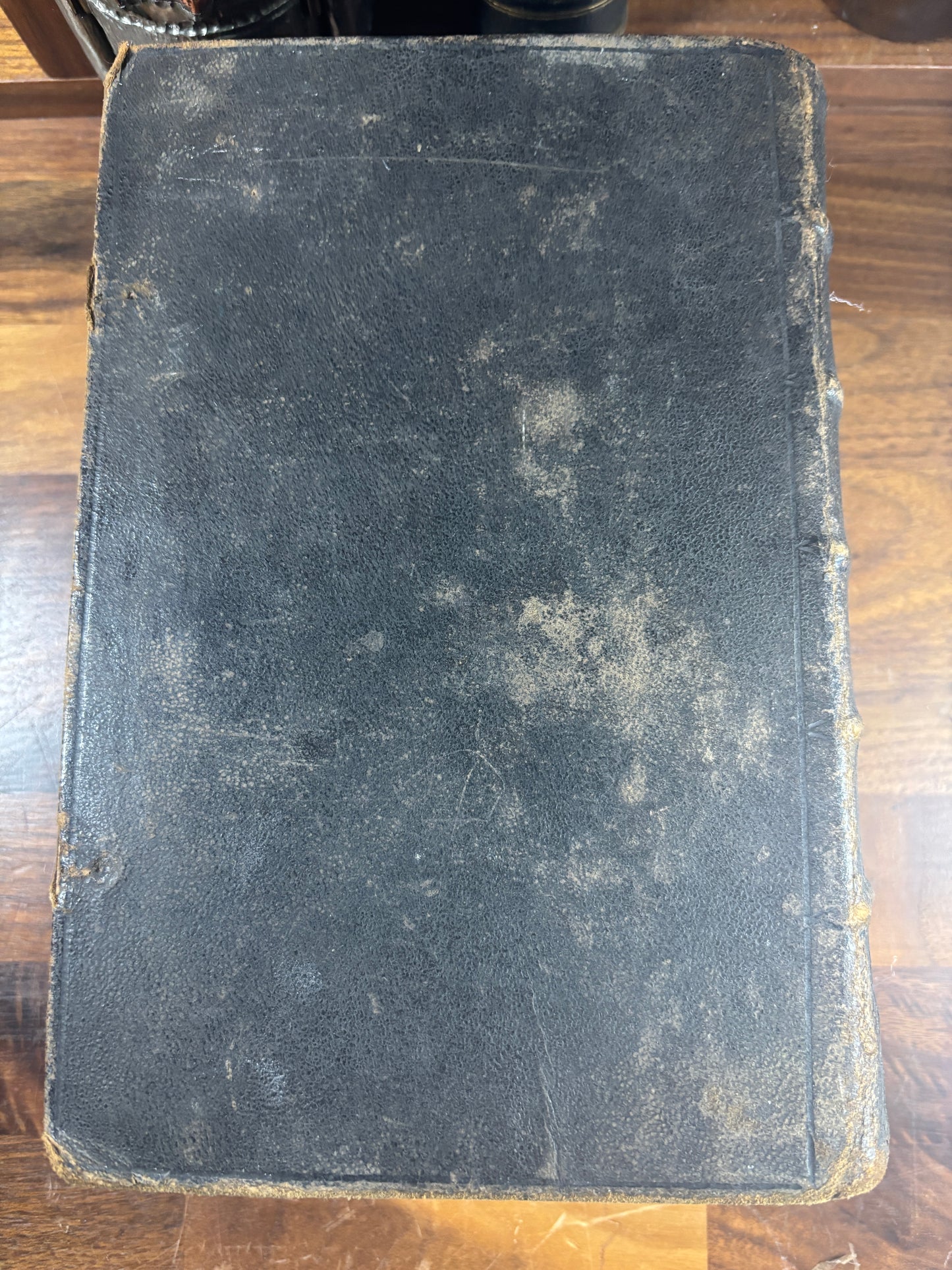
The volume retains a substantial early leather binding over boards with raised bands to the spine and blind-ruled decoration to the boards. The spine bears an abbreviated identification consistent with Pars Hiemalis.
The binding displays considerable age and use, with rubbing, leather loss, cracking and wear to the spine, joints, corners and board edges. There are possible indications that the volume may once have possessed additional fastening furniture or clasps.
Internally the volume presents considerably better, with generally strong paper and crisp printing. There is expected age toning, occasional staining, foxing, creasing and edge wear. The red printing remains particularly vivid.
The volume has not been bibliographically collated leaf-by-leaf, and completeness should therefore not be assumed. It represents the Pars Hiemalis rather than a complete multi-volume seasonal set of the Benedictine breviary.
Historical Context
Printed in Venice in 1728, this breviary appeared when Venice remained one of Europe's great centres of book production, despite the political decline of the Venetian Republic.
The Pezzana press was particularly associated with Catholic and liturgical printing. Nicola Pezzana's name appears on numerous ecclesiastical works produced in Venice during this period, including breviaries and related liturgical publications.
This volume is especially evocative because it was not frozen in 1728. The later additions show it remaining useful as new saints and offices entered the authorised liturgy. Almost three centuries later, those additions allow the history of the book's continued religious use to be seen directly within its pages.
Condition
Good antiquarian condition overall, with substantial wear to the binding.
- Early leather binding heavily rubbed and worn, with areas of leather loss and cracking
- Corners and board edges worn
- Spine and joints show significant age-related wear
- Possible evidence of former clasps or furniture
- Text block generally sound and considerably better preserved than the exterior
- Expected toning, occasional foxing, staining, creasing and minor edge wear
- Red-and-black printing remains strong and attractive
- Later eighteenth-century printed supplements bound in
- Not collated leaf-by-leaf and sold as such
Dimensions:
Weight - 2.42kg
Height - 24cm
Width - 17cm
Thickness - 9.8cm
Share