Momo Rare Books
1632 Greek New Testament, Cambridge, Printed by Thomas Buck W/ Inscription
1632 Greek New Testament, Cambridge, Printed by Thomas Buck W/ Inscription
Couldn't load pickup availability
Η ΚΑΙΝΗ ΔΙΑΘΗΚΗ – Novum Testamentum
Cambridge: Thomas Buck, 1632
Greek New Testament
Octavo
Description
An attractive and scarce 1632 Cambridge printing of the New Testament in the original Greek, printed by Thomas Buck during the reign of Charles I.
The work is entirely printed in Greek and retains its striking engraved architectural title page, reading Η ΚΑΙΝΗ ΔΙΑΘΗΚΗ / Novum Testamentum / Cantabrigiae / Apud Tho: Buck / Anno Domini 1632.
This is an important early English printing of the Greek New Testament. Bibliographical sources differ over its precise position among the earliest Cambridge Greek Testaments, with some describing it as the first Cambridge edition and others recording an earlier 1625 printing. It is nevertheless one of the earliest Greek New Testaments printed in England.
The text was based upon the 1624 Elzevir Greek New Testament, belonging to the printed Greek textual tradition that subsequently became widely known as the Textus Receptus. The edition was produced using Greek type associated with Sir Henry Savile's celebrated scholarly printing at Oxford.
The book concludes on page 648 with ΤΕΛΟΣ ("The End"), and the New Testament text appears complete.
Provenance & Early Annotations
Of particular interest are the numerous signs of early ownership and use.
The engraved title bears what appears to be an early ownership inscription of "Robt. Lewin M.D.", accompanied by the date 1641, only nine years after publication.
Further nineteenth-century inscriptions appear on the preliminary leaves, including an apparently 1848 Trinity College Dublin association, together with another inscription referring to Clare College and dated April 1865.
There are also occasional early manuscript annotations within the text. These inscriptions provide an interesting record of the book's continued scholarly or devotional use across several centuries.
Binding
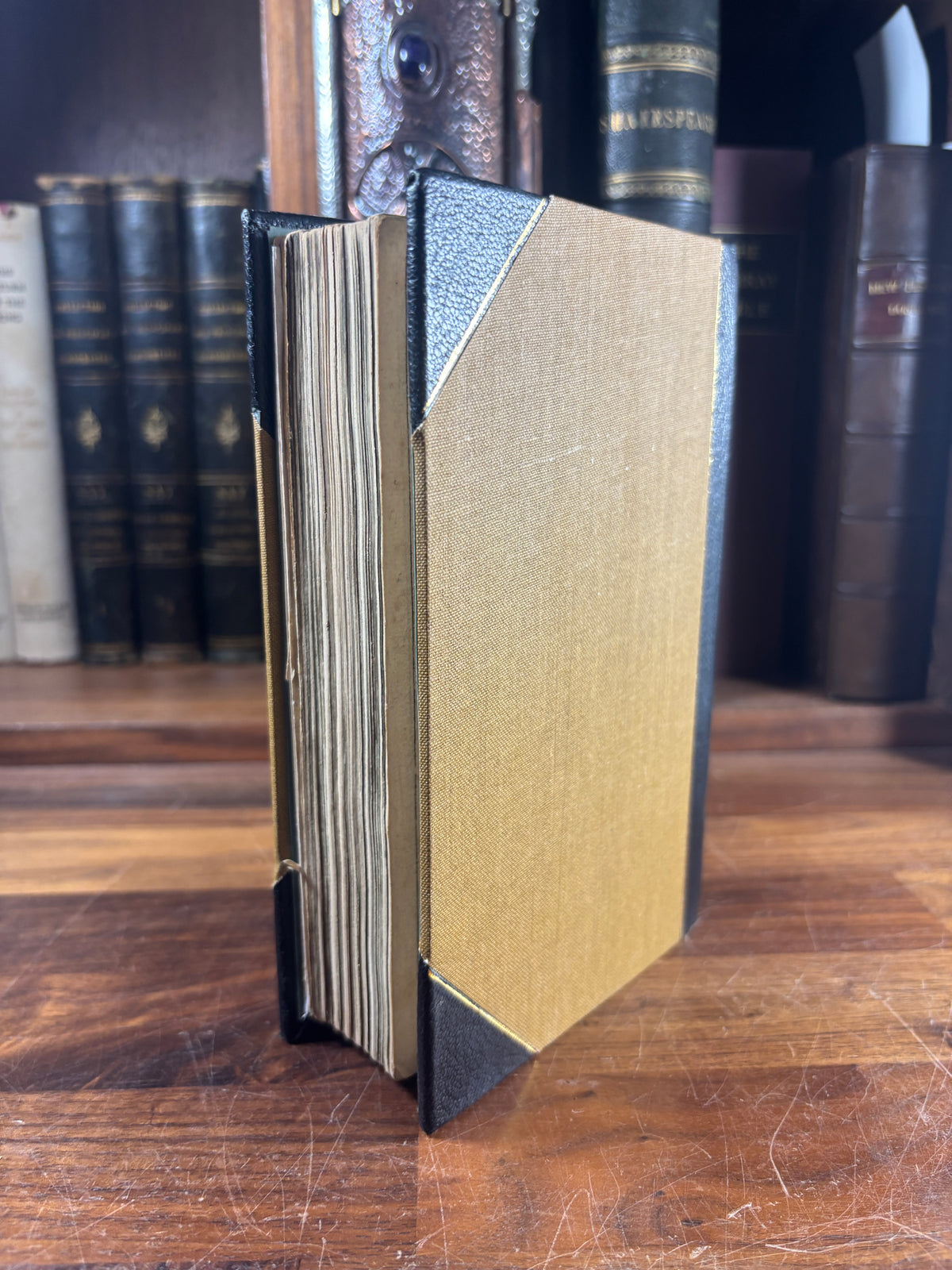
The Bible has been rebound at a later date, probably during the nineteenth or early twentieth century, in black leather over tan cloth boards with matching leather corners.
The spine is lettered in gilt:
NEW TESTAMENT
GREEK BIBLE
1632
The later binding has protected what is now a nearly four-hundred-year-old text block while retaining the earlier inscriptions and evidence of ownership.
Collation & Maps
The edition is bibliographically recorded as:
[2], 624, 627–648 pages, with two leaves of plates, one folding, containing maps.
The apparent jump from page 624 to 627 is part of the edition's pagination and should not itself be mistaken for missing text.
The Greek New Testament text is complete through page 648, terminating with ΤΕΛΟΣ. The engraved title page is also present.
The two separately inserted map plates are lacking, with evidence within the text block indicating where the plates were formerly bound and subsequently removed. The loss of these maps is also encountered in other surviving examples, including the copy held by the Folger Shakespeare Library.
Condition
A very good surviving example for a book approaching four centuries of age.
The text block shows expected age toning, occasional spotting, staining and handling marks, together with scattered manuscript annotations. There are occasional small tears and historic repairs. The engraved title shows wear and an old horizontal crease or repaired split.
Later binding with general shelf wear but remaining secure and presentable.
Complete as to the printed Greek New Testament text and retaining the engraved title; lacking the two separately inserted map plates.
Historical Significance
Printed in Cambridge in 1632, this New Testament appeared during a particularly important period in English religious and intellectual history.
The Authorized Version had appeared only twenty-one years earlier in 1611, while scholars continued to study and publish the Scriptures in their original languages. Greek New Testaments such as this were scholarly books, intended for readers capable of engaging directly with the language of the New Testament rather than relying solely upon an English translation.
Its publication also came during the reign of Charles I, less than a decade before the political and religious crises that culminated in the English Civil War.
The apparent 1641 inscription is particularly evocative in this context, dating from the very eve of that upheaval.
Dimensions:
Weight - 590g
Height - 18.5cm
Width - 12.3cm
Thickness - 3.5cm
Share