Momo Rare Books
1620 King James Collected Works, 1616 Title Page, Daemonologie, Shakespeare Era
1620 King James Collected Works, 1616 Title Page, Daemonologie, Shakespeare Era
Couldn't load pickup availability
Overview:
- Title: The Workes of the Most High and Mightie Prince, Iames
- Author: King James VI of Scotland and I of England (1566–1625)
- Editor: James Montagu, Bishop of Winchester
- Printer: Robert Barker and John Bill, Printers to the King's Most Excellent Majesty
- Place of Publication: London, England
- Date: 1616, expanded and reissued in 1620
- Edition: First collected edition, expanded 1620 issue
- Reference: STC 14345
- Pagination: 621 numbered pages, with preliminary material
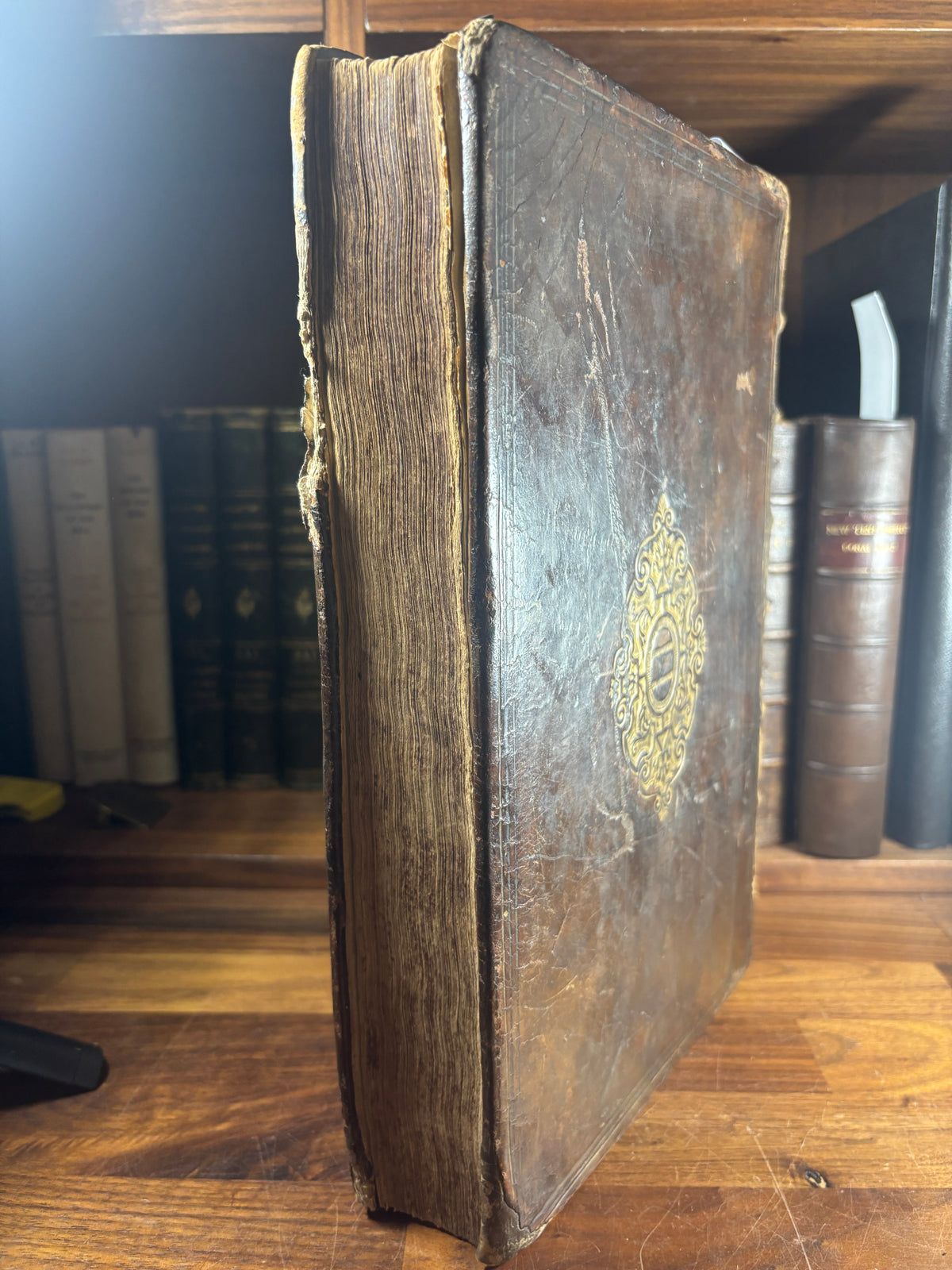
- Binding: Early full calf with gilt decoration
Description
An important early seventeenth-century collection of the writings of King James VI of Scotland and I of England, the monarch responsible for commissioning the King James Bible of 1611 and a significant figure in the political, religious and intellectual history of Britain.
Originally published in 1616, this example belongs to the expanded 1620 issue, retaining the original 1616 title page while incorporating additional writings. The volume concludes at page 621 and includes a separately dated 1620 imprint.
The collection brings together the King's writings on monarchy, religion, witchcraft, political authority and theological controversy, offering a remarkable insight into the beliefs and concerns of one of Britain's most influential rulers.
Among its most celebrated contents is Daemonologie, King James's treatise on witchcraft and the supernatural, a work closely associated with the intellectual background of William Shakespeare's Macbeth.
The volume is further distinguished by its early calf binding, featuring an elaborate gilt central ornament, raised spine bands and a gilt-lettered title label.
King James I and the History of the Period
James VI became King of Scotland in 1567 and succeeded Elizabeth I as James I of England in 1603, uniting the crowns of England and Scotland under a single monarch.
His reign witnessed major religious and political developments, including the Gunpowder Plot of 1605, disputes concerning royal authority and the publication of the King James Bible in 1611.
Unlike many European monarchs of his time, James was also a prolific author. His writings defended the divine right of kings, explored theological controversies and addressed subjects ranging from political government to witchcraft.
This collected edition represents an important attempt to preserve and present the King's intellectual legacy during his lifetime.
Daemonologie and Shakespeare's Macbeth
One of the most historically fascinating works associated with this collection is Daemonologie, originally published in Edinburgh in 1597.
Written by James VI before his accession to the English throne, Daemonologie examines witchcraft, demonic activity, spirits and the supposed practices of witches. James was deeply interested in the supernatural, particularly following the North Berwick witch trials of 1590–1591, which involved allegations of witchcraft directed against the King and his wife, Anne of Denmark.
The treatise defended the reality of witchcraft and argued for the prosecution of those believed to practise it.
This fascination with witchcraft is particularly significant in relation to William Shakespeare's Macbeth, generally dated to around 1606.
Shakespeare's tragedy was written during the early years of James's English reign and reflects several subjects of particular interest to the monarch, including witchcraft, prophecy, regicide and the legitimacy of kingship.
The famous Three Witches of Macbeth, with their supernatural predictions and involvement in the downfall of a king, belong to the same culture of witchcraft belief explored in James's Daemonologie.
Scholars have frequently identified Daemonologie as an important possible influence on Shakespeare's treatment of witchcraft, although direct textual dependence cannot be established with certainty. Shakespeare also drew heavily upon historical chronicles, particularly those of Raphael Holinshed.
Macbeth additionally contains a flattering representation of Banquo, whom the Stuart dynasty traditionally claimed as an ancestor, further strengthening the play's connections with James I.
An important distinction is that Shakespeare's Macbeth predates this collected edition. The influence therefore relates to the original 1597 publication of Daemonologie, rather than the present 1616/1620 volume.
Nevertheless, this book preserves the writings and ideas of the very monarch whose interests helped shape the cultural environment in which Macbeth was written.
Contents and Historical Significance
The collected works encompass several of James's most important writings, including:
Daemonologie, concerning witchcraft, demons and supernatural phenomena.
Basilikon Doron, a treatise offering advice on kingship and government, originally composed for James's son, Prince Henry.
The Trew Law of Free Monarchies, defending hereditary monarchy and the divine authority of kings.
A Premonition to All Most Mightie Monarches, addressing religious and political disputes in Europe.
A Defence of the Right of Kings, concerning royal authority and political allegiance.
Speeches and declarations addressing the religious and political controversies of James's reign, including the aftermath of the Gunpowder Plot.
The expanded 1620 issue additionally contains A Meditation upon the Lords Prayer and other material not included in the original issue.
Together, these writings provide an unusually direct account of the religious convictions, political philosophy and personal interests of the monarch.
The Printers: Robert Barker and John Bill
The volume was printed in London by Robert Barker and John Bill, both associated with the royal printing establishment.
Robert Barker is particularly notable as the printer of the first edition of the King James Bible in 1611, one of the most influential publications in the history of the English language.
The association with Barker provides an additional connection between this volume and the religious publishing programme of James I.
Illustrations and Decorative Features
The volume includes elaborate engraved and typographical decoration, including an engraved royal portrait, architectural title page, royal heraldic imagery, ornamental initials and decorative headpieces.
These illustrations reflect the prestige of a publication devoted to the writings of the reigning monarch.
The engraved and decorative elements are among the most visually attractive features of this edition.
Binding
Bound in early full brown calf, featuring blind-ruled borders and an elaborate gilt central ornament to the boards.
The spine features raised bands and a gilt-lettered title label reading KING JAMES WORKES.
The binding appears to have undergone historical restoration or repair, potentially including work to the spine and joints. The early boards may have been retained during this process, preserving much of the volume's original character.
The precise date and extent of the binding restoration have not been established.
Condition and Collation
An approximately 400-year-old volume displaying considerable historical character and wear consistent with its age.
The leather binding exhibits rubbing, scratches, scuffing, surface cracking and losses, particularly around the spine ends, corners and extremities. Evidence of previous binding repairs or restoration is apparent.
Internally, the leaves exhibit age-related toning, occasional spotting, staining and handling marks. Several leaves, including preliminary and terminal material, show evidence of historical repairs.
The main pagination concludes at page 621, corresponding to the expanded 1620 issue of the first collected edition.
The engraved illustrations and decorative typographical features remain attractive.
Why This Book Is Collectable
This is an important early collected edition of the writings of a reigning British monarch, published during his lifetime and preserving his views on religion, witchcraft and royal authority.
Its appeal extends across several collecting fields, including Stuart history, early English printing, royal literature, demonology, Shakespearean studies and the history of the King James Bible.
The inclusion of Daemonologie is especially noteworthy because of its relationship to the witchcraft beliefs that informed the world of Shakespeare's Macbeth.
Combined with its early gilt-decorated calf binding and association with Robert Barker, printer of the 1611 King James Bible, this is a historically significant and visually impressive seventeenth-century volume.
Dimensions:
Weight - 2.24kg
Height - 33.5cm
Width - 22.5cm
Thickness - 4.8cm
Share