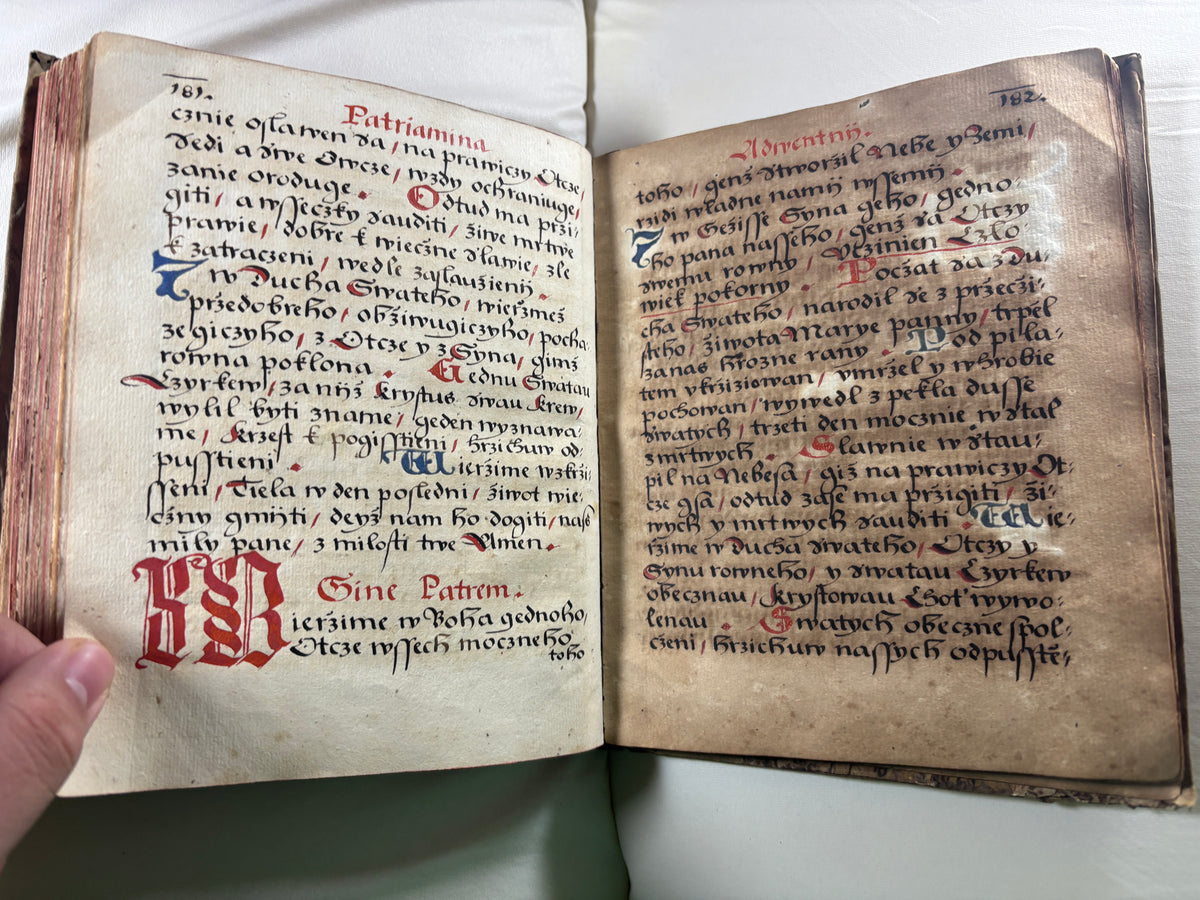
Overview:
- Date: 1620
- Place: Bohemia, probably western Bohemia
- Language: Czech, with Latin liturgical terminology
- Number of leaves: 254
- Format: Manuscript on paper
- Binding: Early vellum binding
- Decoration: Red and blue initials and extensive rubrication
- Subject: Christian devotion, liturgy, prayers and hymns
Description
A remarkable early 17th-century Czech manuscript prayer book, dated 1620 and written by hand in the Czech vernacular.
The substantial manuscript contains 254 numbered pages of religious and liturgical texts, beautifully presented in black and red ink and decorated throughout with numerous large initials executed in red and blue. Rather than being a simple notebook of private prayers, the manuscript is carefully structured, with recurring headings identifying prayers, hymns and liturgical sections.
Among the terminology visible throughout are Píseň (song or hymn), Prosa (in a liturgical context, a sequence), Kyrie, Christe, Marian references including the Virgin Mary and Mother of God, and other material relating to the Christian liturgical cycle.
The manuscript belongs broadly to the tradition of vernacular devotional books that developed from the medieval Book of Hours, although its precise classification remains worthy of further scholarly study. It may represent a specifically Bohemian form of prayer book or liturgical/devotional collection rather than a conventional Latin Horae.
The Date: Bohemia in 1620
The date of the manuscript is particularly significant.
1620 was one of the defining years of Czech and Bohemian history. On 8 November, the Battle of White Mountain was fought outside Prague between the forces of the Bohemian Revolt and those of Emperor Ferdinand II and the Catholic League.
The defeat of the Bohemian estates brought the revolt to an end and was followed by enormous religious and political change throughout the Kingdom of Bohemia, including the strengthening of Habsburg authority and an extensive programme of re-Catholicisation.
This manuscript therefore survives from the very year in which the religious landscape of Bohemia changed dramatically.
Its precise confessional background has not yet been established and should not be assumed solely from its date or devotional contents.
Decoration
Throughout the manuscript are large ornamental initials executed in red and blue, accompanied by rubricated headings, flourishes and smaller coloured initials. The decoration is remarkably consistent throughout the volume and demonstrates that considerable care was taken in its production.
Containing combination of decorative initials, rubrication and carefully organised text.
Bound in an early vellum binding with red-coloured page edges.
The vellum has developed considerable surface wear, staining, creasing and losses through approximately four centuries of use. Early manuscript inscriptions are present on the binding, including the date 1620.
The binding is an important part of the history of the manuscript and has therefore been retained in its present state.
Condition
A substantial early 17th-century manuscript showing considerable evidence of age and use.
The vellum binding is heavily worn, stained and creased, with losses and deterioration particularly around the spine and extremities. The text block exhibits general toning, staining, handling marks and occasional wear consistent with its age.
Internally, however, the manuscript remains remarkably attractive. The black manuscript text remains generally strong and legible, while the red and blue decoration retains considerable colour.
Pagination extends beyond 250 pages. The manuscript has not yet been fully collated and is therefore offered without guarantee of completeness.
Who would have used this?
We can take a guess at whom might have own or used this book in the past:
-
A priest: certainly possible, although the extensive use of vernacular Czech rather than Latin may suggest that it was not produced primarily as a conventional clerical service book.
-
An educated layperson: perhaps a prosperous merchant, skilled craftsman, bailiff or other member of the educated urban middle classes. Such individuals could participate actively in religious confraternities and church life and had both the literacy and resources to own devotional manuscripts.
-
A monk/scribe: possible, although at present there is no clear evidence connecting the manuscript with a particular monastery or religious order. Again, its predominantly Czech text rather than Latin makes a conventional monastic service book less likely.
-
A wealthy or educated woman: vernacular devotional books were particularly important to lay readers who did not possess the Latin education expected of the clergy and university-educated elite. Women were important owners and patrons of devotional manuscripts, making female ownership entirely plausible, although there is presently no evidence identifying the original owner as a woman.
-
A marriage gift or dowry possession: devotional books could be given at marriage or pass into a household as part of a woman's personal possessions. A carefully produced religious manuscript could therefore have had a familial or marital context. However, no inscription, heraldry or other provenance presently connects this manuscript with a marriage or dowry, so this remains speculative.
Why Buy This Manuscript?
Produced more than 400 years ago, this is an unusual survival of Czech religious manuscript culture from one of the most consequential years in Bohemian history.
Its vernacular Czech text, extensive rubrication, decorative red and blue initials, early vellum binding and 1620 date make it considerably more visually and historically interesting than a typical post-medieval devotional manuscript.
Most importantly, this is not a later printed prayer book imitating an older tradition. Every page was individually written and decorated by hand, at a time when manuscript production was increasingly being displaced by the printing press.
A striking and highly unusual early 17th-century Czech devotional manuscript, worthy of further scholarly investigation.
Dimensions:
- Weight - 546g
- Height - 20.7cm
- Width - 16.2cm
- Thickness - 3.6cm