Momo Rare Books
1616 Geneva "Breeches" Bible Folio, Herbert 348, Genealogies & Woodcut Prints
1616 Geneva "Breeches" Bible Folio, Herbert 348, Genealogies & Woodcut Prints
Couldn't load pickup availability
A magnificent Jacobean folio Geneva Bible, printed in London in 1616 by Robert Barker, Printer to King James I, complete with its highly decorative general title page and accompanied by John Speed's celebrated biblical genealogies and illustrations.
This is Herbert 348, one of the imposing folio editions of the Geneva Bible produced during the reign of James I. The text is printed principally in handsome double-column black letter with extensive marginal annotations characteristic of the Geneva tradition.
The volume is especially attractive for the wealth of supplementary material bound with it. Among its most striking features is the spectacular full-page Adam and Eve in the Garden of Eden engraving, showing the Tree of Knowledge surrounded by the animals of Creation. The illustration faces the richly ornamented 1616 general title page, creating one of the most impressive openings found in an early English Bible.
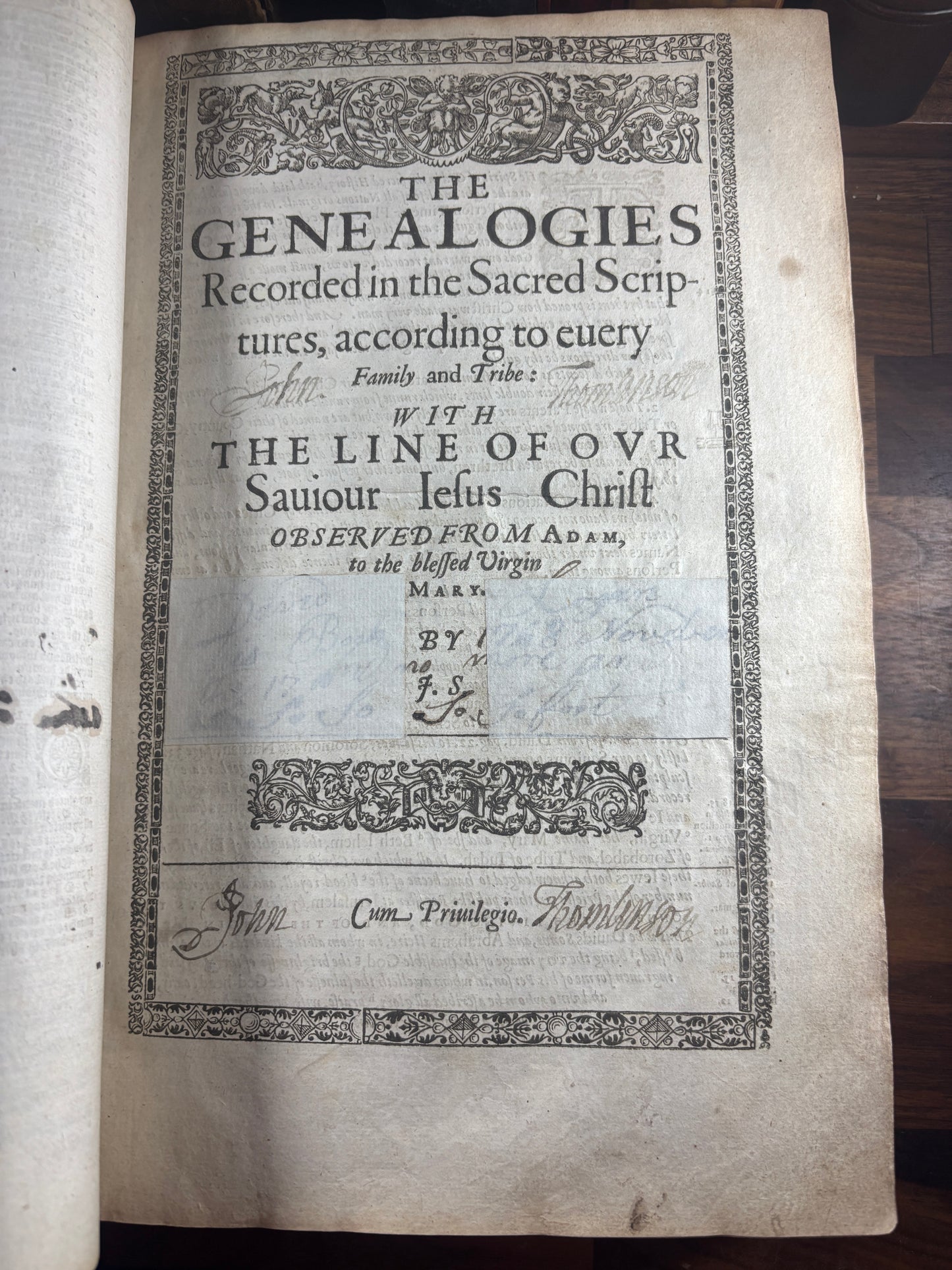
Bound at the front is a 1616 Book of Common Prayer, followed by the biblical genealogical material associated with John Speed, including extensive woodcut family trees, maps, architectural diagrams and illustrations.
At the rear is The Whole Booke of Psalmes, printed in London for the Company of Stationers in 1624, with musical notation for singing the Psalms.
An exceptionally handsome example of the late Geneva Bible tradition, produced only five years after the first King James Bible and at a moment when the Geneva and Authorized versions were competing for English readers.
The 1616 Geneva Bible:
The general title reads:
THE BIBLE: THAT IS, THE HOLY SCRIPTURES contained in the Old and New Testament.
Imprinted at London by Robert Barker, Printer to the Kings most Excellent Maiestie. Anno Dom. 1616.
The elaborate architectural title border incorporates angels, royal devices and biblical imagery. At its summit appears the Hebrew יהוה, representing the divine name YHWH.
An open book above the title bears the Latin motto:
VERBVM DEI MANET IN AETERNVM
"The Word of God endureth forever."
Robert Barker was the King's Printer and one of the most important figures in early seventeenth-century English Bible production. Only five years before this volume appeared, Barker's press had produced the monumental first edition of the King James Bible.
Despite Barker's involvement with the Authorized Version, the Geneva Bible remained enormously popular, and editions continued to be produced during James's reign.
The present Bible retains the Apocrypha and its separate 1616 New Testament title page. The New Testament follows the Geneva tradition associated with Laurence Tomson, while Revelation incorporates the annotations associated with Franciscus Junius.
The Geneva Bible is particularly famous for its extensive marginal notes, which made it not merely a text for reading but effectively a biblical study book.
The Garden of Eden:
One of the great visual features of this copy is the large full-page engraving of Adam and Eve in the Garden of Eden associated with the genealogical material of John Speed.
Adam and Eve stand on either side of the Tree of Knowledge, around which the serpent coils. Above them, surrounded by clouds and divine light, appears the Hebrew name of God.
The composition is filled with animals representing Creation, including elephants, lions, cattle, deer, horses, birds and numerous other creatures.
Banners winding through the tree and figures recount the theological narrative of Creation, temptation and the Fall.
This extraordinary illustration survives opposite the equally elaborate 1616 Bible title page, producing a particularly impressive double-page opening.
A comparable Herbert 348 is likewise recorded with the full-page Adam and Eve frontispiece and Speed genealogical material.
John Speed's Genealogies and Biblical Illustrations:
Bound with the Bible is the celebrated genealogical material associated with John Speed, one of the most important English cartographers and historians of the early seventeenth century.
The genealogies were intended to help readers understand the complex family relationships described throughout Scripture.
Rather than presenting genealogy purely as text, the work employs elaborate woodcut family trees and diagrams to trace biblical descent.
The supplementary material also contains particularly attractive architectural and biblical illustrations, including representations connected with the Temple of Solomon.
These illustrations substantially increase the visual appeal of the volume and provide a fascinating example of how Jacobean readers were encouraged to understand the geography, architecture and genealogy of the biblical world.
The 1624 Metrical Psalms:
Bound at the rear is:
THE WHOLE BOOKE OF PSALMES. COLLECTED INTO ENGLISH MEETER, by Thomas Sternhold, John Hopkins, and others...
Imprinted for the Companie of Stationers. 1624.
This is particularly attractive because it retains its printed musical notation.
These were not simply Psalms intended for private reading. The metrical translations were designed to be sung, allowing congregations and households to perform the Psalms communally.
The title specifically advertises that the Psalms contain "apt Notes to Sing them withall."
The presence of the 1624 Psalter alongside the Bible and Prayer Book gives the volume something close to the character of a complete Jacobean devotional library: prayer, Scripture and sacred music contained within a single binding.
The same combination of a 1616 Barker Bible with 1616 BCP and 1624 Company of Stationers Psalms is documented in another Herbert 348 folio.
History of the Time: England in 1616:
This Bible was printed during the reign of James I, at an extraordinary moment in English religious and literary history.
Only five years had passed since the publication of the King James Bible in 1611.
Yet the appearance of the Authorized Version did not immediately displace the Geneva Bible.
The Geneva translation had originated among English Protestant exiles during the reign of the Catholic Queen Mary I. First published as a complete Bible in 1560, it became one of the most influential English Bibles of the Elizabethan and early Jacobean periods.
Its compact scholarship, accessible language and extensive explanatory annotations made it immensely popular for private study.
By 1616, however, it existed alongside a formidable new rival.
King James had authorised a new translation partly because of dissatisfaction with existing English Bibles, including some of the politically charged annotations found in the Geneva Bible. The resulting Authorized Version appeared in 1611.
This volume was therefore produced during the fascinating transitional period in which the Geneva Bible and King James Bible were circulating simultaneously.
Robert Barker stood directly at the centre of that transition. As King's Printer, his press was responsible for printing the Authorized Version, yet Barker also continued producing Geneva Bibles for a market that plainly still wanted them.
The year 1616 is itself evocative in English cultural history. William Shakespeare died on 23 April 1616, while writers such as Ben Jonson remained active at the heart of Jacobean literary culture.
Across the Atlantic, the English colony at Jamestown was less than a decade old. English expansion overseas was accelerating, while religious tensions that would eventually contribute to the migrations of English Puritans to North America were already developing.
Within another generation England would descend into Civil War.
This Bible therefore belongs to the world immediately preceding those enormous political and religious upheavals: the England of James I, Shakespeare, the early King James Bible and the beginnings of permanent English settlement in North America.
The Binding:
The volume is housed in an exceptionally handsome black morocco binding, extensively decorated in gilt.
Both boards carry elaborate gilt borders and central ornamental devices, complemented by gilt decoration around the board edges. The text-block edges are also gilt.
The binding displays expected rubbing, scratching and general evidence of age and use, but remains highly decorative and gives the substantial folio an imposing appearance.
I would be slightly cautious about assigning an exact date to the binding without physical examination by a binding specialist. It has considerable age and is clearly an important feature of the book, but it is safer commercially to describe it on its physical merits rather than definitively calling it the original 1616 binding.
Contents:
The volume includes, among other material:
- The Book of Common Prayer, 1616
- John Speed's biblical Genealogies
- Full-page Adam and Eve / Garden of Eden engraving
- Genealogical woodcuts and diagrams
- Biblical maps and architectural illustrations
- 1616 Geneva Bible general title
- Old Testament
- Apocrypha
- 1616 New Testament title
- Tomson/Junius New Testament material
- Extensive Geneva marginal annotations
- The Whole Booke of Psalmes, 1624
- Printed musical notation
The main Bible corresponds to Herbert 348.
Condition:
A remarkably attractive early seventeenth-century folio Bible showing expected evidence of more than four centuries of use.
The text is generally well preserved and remains highly legible. There is expected age toning, occasional spotting, staining, handling marks, marginal wear and other imperfections throughout.
Some leaves exhibit marginal tears, creasing or historical repairs. The supplementary material and illustrations show varying degrees of age and use.
The important 1616 general title page survives with its elaborate printed border substantially intact. The full-page Garden of Eden engraving is also present and remains particularly striking.
The 1616 New Testament title page is present.
The 1624 Psalter retains examples of its printed musical notation.
The black morocco binding shows rubbing, scratches, marks and wear commensurate with age, while the gilt decoration and gilt text-block edges remain visually impressive.
Please examine all photographs carefully as these form an important part of the condition description.
Why Buy This Copy?
This is considerably more than an isolated early Bible.
It brings together the Geneva Bible, Book of Common Prayer, John Speed's biblical genealogies and illustrations, and Sternhold & Hopkins's musical Psalms within a single imposing folio volume.
The spectacular Adam and Eve engraving, architectural illustrations, black-letter typography, extensive Geneva annotations, separate 1616 titles, musical notation and richly gilt binding make it an unusually visual example of early seventeenth-century English biblical printing.
Most importantly, it was printed in 1616, only five years after the first King James Bible, by Robert Barker himself, the royal printer responsible for both traditions.
It represents a remarkable moment when two of the most important English Bible traditions existed side by side: the old Geneva Bible that had shaped generations of English Protestant readers, and the new King James Bible that would eventually supersede it.
For a collector of early English Bibles, Reformation history, Jacobean printing, biblical illustration or seventeenth-century religious culture, this is a particularly impressive volume.
Dimensions:
Weight - 3.31kg
Height - 32.5cm
Width - 22.5cm
Thickness - 7.5cm
Share