Momo Rare Books
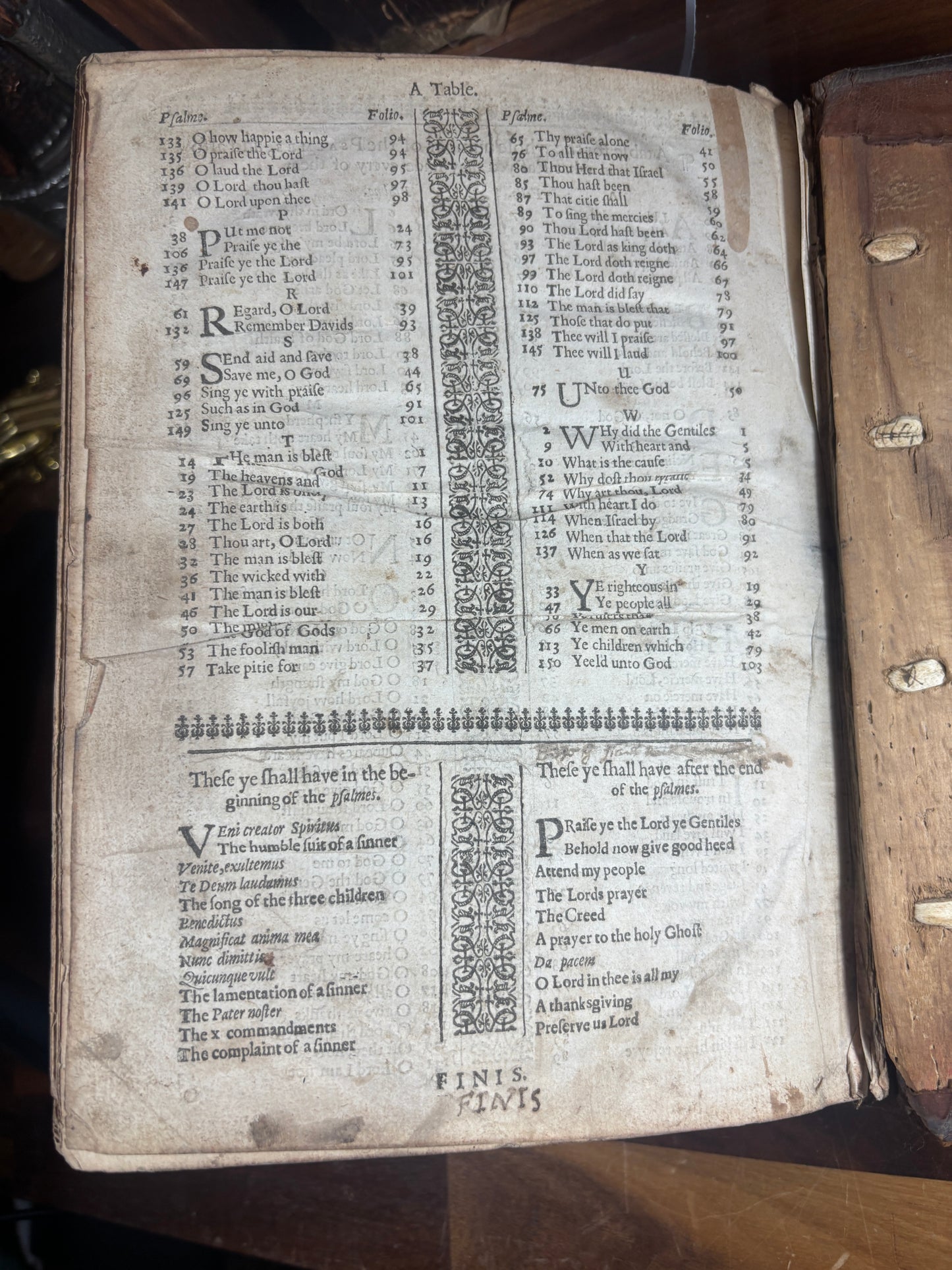
1608 Geneva Bible W/ Blind-Tooled Calf Binding, Bound W/ 1634 Psalter
1608 Geneva Bible W/ Blind-Tooled Calf Binding, Bound W/ 1634 Psalter
Couldn't load pickup availability
Offered here is a handsome and historically significant Geneva Bible, printed in London by Robert Barker in 1608, preserved in its contemporary blind-tooled calf binding over wooden boards. A well-used family Bible for generations, this copy bears numerous early ownership inscriptions, remnants of its original brass clasps, and retains much of its seventeenth-century character.
The Geneva Bible remains one of the most influential English translations ever produced. First published in Geneva by English Protestant exiles during the reign of Mary I, it became the household Bible of Elizabethan and Jacobean England. Its extensive marginal notes, clear Roman type, verse numbering, and practical commentary made it immensely popular with ordinary readers and clergy alike.
This copy was printed just three years before the publication of the King James Bible in 1611, at a time when the Geneva Bible remained the preferred translation throughout much of England and Scotland.
Although the general title page is no longer present, the New Testament title page dated 1608 survives, confirming the printing by Robert Barker, King's Printer.
At some point during its working life, the original Psalter was replaced with a 1634 Cambridge printing of The Whole Book of Psalms, demonstrating that this volume continued to be used and maintained well into the seventeenth century.
Despite its faults, this remains an attractive and honest example of one of the most important English Bibles ever printed.
Condition
- Blind-tooled calf over wooden boards.
- Raised bands to spine.
- Remnants of the original brass clasps remain.
- The spine is heavily worn with losses to the leather, exposing portions of the sewing structure, though both boards remain attached.
- General title page absent.
- New Testament title page present dated 1608.
- Later Cambridge Psalter dated 1634 inserted.
- One leaf within Hebrews has substantial loss, together with the usual scattered wear expected from centuries of use. Further collation is recommended, and the volume is offered as photographed.
- Paper generally clean with pleasing wide margins.
- An attractive unrestored seventeenth-century binding retaining excellent historical character.
- Foxing and staining can be found throughout.
- Minor page repairs can be found on occasion
- some tearing can be found within.
Provenance & Inscriptions:
This Bible preserves evidence of several generations of ownership.
The contemporary binding is stamped with the initials "E.H.", almost certainly those of an early owner.
Among the surviving manuscript inscriptions are:
- "Benjamin Brewer's Booke", written on one of the concluding leaves of the Old Testament.
- Several ownership signatures attributed to John Shorely (or Shoreley).
- Additional ownership inscriptions relating to a Thomas whose surname is now largely obscured.
- Numerous contemporary pen trials and decorative flourishes scattered throughout the preliminary leaves.
A modern bookplate for Michael Stoughton records a more recent collector.
These inscriptions provide a tangible record of the Bible's long history of ownership and devotional use across more than four centuries.
On Michael Stoughton:
Affixed to the front pastedown is the armorial bookplate of Michael Stoughton, a noted private collector whose library focused on early printed books, particularly English Bibles and works relating to the Reformation. Books bearing his bookplate have appeared in specialist antiquarian book auctions in recent years, including numerous Geneva Bibles, early King James Bibles, Douay-Rheims Bibles, and even fifteenth-century incunabula.
Historical Background:
When this Bible was printed in 1608, England stood at a pivotal moment in its religious history.
King James VI of Scotland had become James I of England only five years earlier, uniting the English and Scottish crowns. Religious divisions remained pronounced, with Puritans seeking further reform of the Church of England while the monarchy sought greater religious uniformity.
Although James had already commissioned a new English translation of the Scriptures at the Hampton Court Conference in 1604, the King James Bible would not appear until 1611. Consequently, the Geneva Bible continued to dominate English households during this period.
Indeed, many of the Pilgrim Fathers who later sailed aboard the Mayflower in 1620 carried Geneva Bibles rather than the newly published King James Version.
Printed during this brief but significant period, this volume represents the final flourishing of the Geneva tradition before the King James Bible gradually replaced it throughout Britain.
Bibliographical Notes
- Bible: Geneva Version
- Printer: Robert Barker
- Place: London
- Date: 1608
- Language: English
- Binding: Contemporary blind-tooled calf over wooden boards
- Later Addition: The Whole Book of Psalms, Cambridge, 1634
Share