Momo Rare Books
1599 Geneva “Breeches” Bible Herbert 253, Maps, Genealogies, Apocrypha, Psalter & Concordance
1599 Geneva “Breeches” Bible Herbert 253, Maps, Genealogies, Apocrypha, Psalter & Concordance
Couldn't load pickup availability
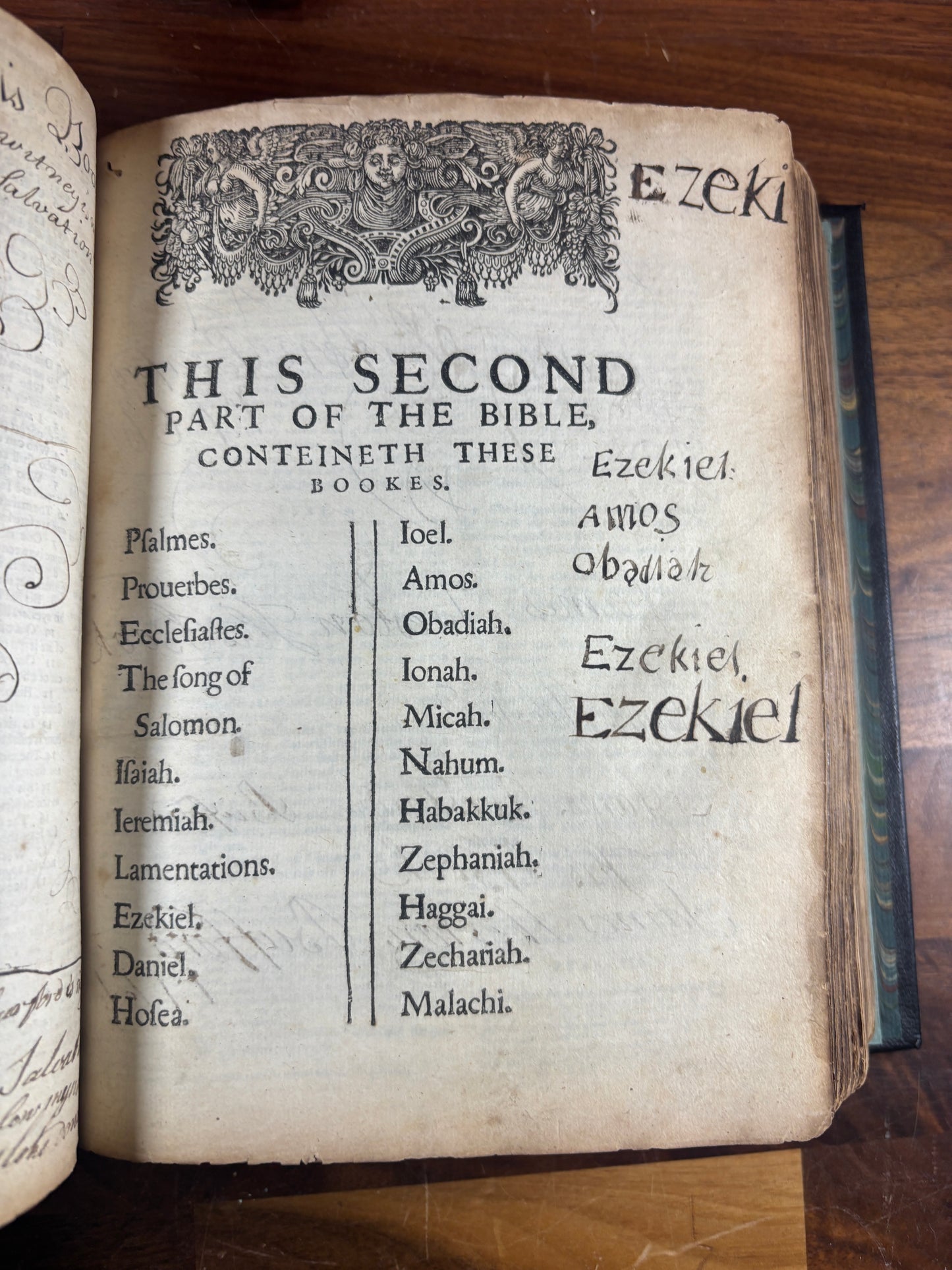
A particularly attractive and extensively illustrated example of the celebrated 1599 Geneva or “Breeches” Bible, retaining numerous maps and woodcut illustrations and bound with an unusually comprehensive collection of supplementary material, including genealogies, a separately printed Apocrypha, concordance and metrical Psalter.
Although the title page states London, 1599, Herbert 253 belongs to the famous group of Geneva Bibles produced in the Low Countries under a false Christopher Barker imprint, generally dated by bibliographers to the 1630s. Comparable copies have been catalogued as Amsterdam, circa 1639.
The “1599” Geneva Bible
First published in 1560 by English Protestant exiles in Geneva, the Geneva Bible became one of the most influential English Bibles of the sixteenth and seventeenth centuries. Its accessible language, extensive marginal commentary and convenient chapter-and-verse arrangement made it enormously popular for private study.
It is popularly known as the “Breeches Bible” from its famous rendering of Genesis 3:7, in which Adam and Eve make themselves “breeches.”
The present edition is identified as Herbert 253, one of the fascinating so-called “1599” Geneva Bibles. Despite the London imprint of the Deputies of Christopher Barker, Herbert 253 is generally attributed to the Netherlands and dated several decades later. Christie's, for example, catalogued the edition as “London, 1599 [i.e. Amsterdam, c.1639]”.
The identification is supported by the characteristic textual setting in Esther, one of the diagnostic features used to distinguish between the numerous editions carrying the same 1599 imprint.
Maps, Genealogies & Woodcut Illustrations
The volume retains an impressive collection of the visual material associated with the Geneva Bible.
Among the illustrations visible within this copy are the Garden of Eden, the Crossing of the Red Sea, the Garments of the High Priest, the Tabernacle, the Altar of Burnt Offering, the Temple, and the particularly striking full-page Vision of Ezekiel.
Also present are biblical maps, including the division of the Holy Land amongst the tribes of Israel, together with genealogical tables tracing the descent of biblical figures from Adam and Eve.
Additional diagrams include the unusual tables of consanguinity and affinity, illustrating degrees of relationship considered impediments to marriage.
These maps, genealogies and woodcuts considerably enhance the appeal of the volume, particularly as such material is frequently defective or absent from surviving Geneva Bibles.
Apocrypha
Of particular interest is the presence of the Apocrypha.
Herbert 253 is ordinarily encountered without the Apocrypha, and bibliographical descriptions specifically note its omission from the edition. Surviving copies, however, were sometimes assembled with material taken from other editions.
The Apocrypha in the present volume appears to be a separately printed component subsequently bound with the Bible. Differences in typography and the lack of continuity in the catchwords between sections support this interpretation.
Rather than being a modern addition, it may represent the manner in which an early owner or bookseller assembled a more comprehensive Bible. Further identification of the signatures and typography of the Apocrypha may allow its particular edition, and consequently its approximate date, to be established.
Concordance & Psalter
The volume is additionally bound with a concordance and metrical Psalter, making this a particularly substantial surviving assemblage.
These supplementary works were separately printed and frequently bound alongside Geneva Bibles according to the requirements of the original purchaser. Consequently, many surviving copies have subsequently lost one or more of these components.
Their survival alongside the Bible, Apocrypha, maps and genealogical material is therefore particularly desirable.
Early Family Records & Provenance
An especially appealing feature of the volume is its extensive manuscript family history.
The inscriptions record members of the Blunt family, including an entry for Henry Blunt, recorded as:
“Born ye 30th of March 1633”
Another entry records a second Henry Blunt, son of Henry and grandson of Edward Blunt, as born 20 May 1676.
A date of 1711 appears in similar handwriting elsewhere amongst the records. This suggests that at least some of the family information was entered retrospectively around the late seventeenth or early eighteenth century rather than contemporaneously in 1633.
The inscriptions should therefore be understood as an early manuscript family register recording events extending back to 1633, rather than evidence that the Bible itself was necessarily in the family's possession by that date.
Later inscriptions include repeated ownership marks of James Weston, including one dated 1766, demonstrating continued ownership and use of the volume well into the eighteenth century.
Together these records provide an unusually tangible record of the Bible's history as a working family book rather than simply a preserved antiquarian object.
Binding
Bound in dark leather over substantial boards, retaining heavily worn and tooled earlier leather to the covers.
The volume has subsequently been rebacked and restored in black leather, with a red morocco spine label lettered in gilt:
GENEVA BIBLE
1599
The earlier boards and leather show considerable age and wear consistent with the long working life of the volume.
Condition
A substantial and extensively preserved example.
Expected age-related toning, staining, spotting and handling throughout, together with occasional marginal wear, tears and old repairs. The 1599 title page has undergone substantial historic restoration and reinforcement, with losses and repairs particularly around the margins.
Numerous early manuscript annotations and ownership inscriptions occur throughout.
Binding restored and rebacked as described, retaining earlier leather-covered boards.
Despite its considerable age and evidence of extensive historical use, the volume remains visually impressive, with strong typography and an exceptional collection of maps, diagrams and woodcut illustrations.
Please examine the photographs.
Dimensions:
Weight - 1.56kg
Height - 22.3cm
Width - 17.5cm
Thickness - 7cm
Share