Momo Rare Books
1583 Greek and Latin New Testament With Extensive Inscriptions
1583 Greek and Latin New Testament With Extensive Inscriptions
Couldn't load pickup availability
Title: Novum Testamentum Graece, cum vulgata interpretatione Latina Graeci contextus lineis inserta
Editor: Benito Arias Montano
Printer: Christophe Plantin
Place: Antwerp
Date: 1583
Language: Ancient Greek & Latin
Volumes: Two
Institutional records confirm the edition as an octavo Greek-Latin New Testament printed at Plantin's Antwerp press in 1583, with the Greek text accompanied by an interlinear Latin version.
This particular example is especially appealing for its extensive early manuscript additions. Numerous leaves have been filled in a historical hand with carefully organised Latin biblical and theological notes, transforming what was already a scholarly Renaissance New Testament into the working reference book of an early reader.
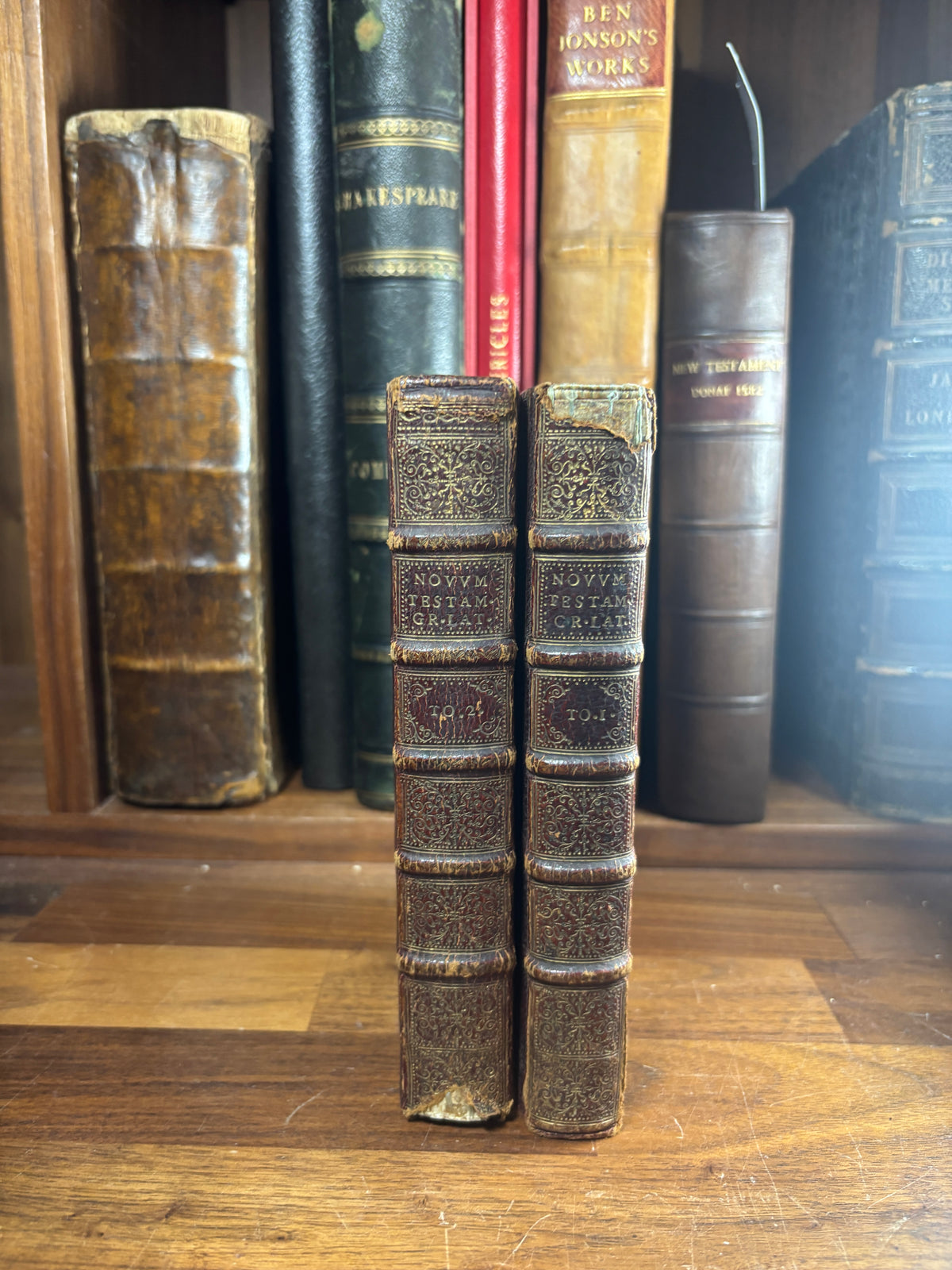
The set survives in two matching volumes in attractive later full leather bindings with elaborate gilt decoration to the spines.
The Text:
This is no ordinary Latin Bible.
The New Testament is printed primarily in Greek, accompanied by Latin text arranged around and between the Greek. The title explains that the Vulgate interpretation is inserted alongside the Greek text, while alternative Latin renderings associated with Benito Arias Montano are used where appropriate.
The result is an extraordinarily intricate piece of Renaissance typography. Greek, Roman and italic types appear together, with interlinear translations, marginal readings, references and annotations all carefully arranged upon the page.
The University Library of Pisa describes the edition as containing the Greek text with an interlinear Latin version, while the National Library of New Zealand similarly catalogues it as Greek and Latin with Latin notes.
The title page bears Plantin's famous printer's device of the compass and the motto "Labore et Constantia", meaning approximately "By Labour and Constancy."
Christophe Plantin and the Plantin Press:
Christophe Plantin was one of the most important printers of the European Renaissance. From Antwerp, his press became an international centre for scholarly, religious and multilingual printing.
Plantin was particularly renowned for the technical difficulty and beauty of his scholarly publications. Printing Greek alongside Latin required specialist type, compositors capable of handling multiple alphabets, and extremely careful page design.
This volume demonstrates that expertise beautifully. The Greek and Latin texts frequently interlock across the page, surrounded by marginal readings and references.
Plantin's connection with Benito Arias Montano was particularly significant. Montano had supervised the monumental Antwerp Polyglot Bible, printed by Plantin between 1568 and 1572. The present New Testament belongs directly to this tradition of multilingual biblical scholarship: the Bibliothèque nationale de France records the related Greek-Latin New Testament material among the Antwerp Polyglot publications and separately records this 1583 edition.
Benito Arias Montano:
Benito Arias Montano was a Spanish theologian, biblical scholar and orientalist and one of the foremost scriptural scholars associated with Plantin's press.
His name appears prominently on the title page of this edition. Rather than simply reproducing a conventional Latin New Testament, the book was intended to allow educated readers to compare the Latin tradition directly against the original Greek.
The National Library of New Zealand catalogues both Arias Montano and Christophe Plantin in connection with the edition, while USTC classifies the work as a multilingual religious publication in Greek and Latin.
History of the Book:
This New Testament was printed in 1583, at the height of the religious and intellectual upheavals of the European Reformation and Counter-Reformation.
Only sixty-six years had passed since Martin Luther's Ninety-five Theses. Europe had subsequently been transformed by disputes concerning biblical authority, translation and interpretation.
The ability to consult Scripture in its original languages became increasingly important to scholars on both sides of the religious divide. Greek New Testaments had consequently become essential instruments of biblical scholarship.
Antwerp occupied a particularly fascinating position within this world. It was one of Europe's great centres of commerce and printing, but the Low Countries were simultaneously being torn apart by religious and political conflict.
Plantin managed to build one of Europe's most important presses within this difficult environment. His scholarly publications brought together sophisticated typography, classical learning and the expanding study of Hebrew, Greek and Latin.
The present edition therefore represents far more than simply another printing of the New Testament. Its arrangement reflects the increasingly scholarly approach to Scripture which characterised sixteenth-century Europe.
The reader could see the Greek and Latin together and examine how individual words and passages had been rendered between languages.
The surviving manuscript commentary in this particular copy demonstrates exactly how such a book could subsequently be used.
Extensive Early Manuscript Commentary:
Perhaps the most fascinating feature of this particular set is the substantial quantity of early manuscript material bound within it.
Numerous pages are covered almost completely in carefully written Latin notes.
These are not merely occasional ownership annotations or a handful of marginal comments. The manuscript material is organised systematically, with repeated headings such as:
Cap. 1
Cap. 2
Cap. 3
and so forth.
References to individual biblical books and passages occur throughout. One clearly visible heading concerns the Epistola ad Romanos, the Epistle to the Romans, while other sections continue through individual chapters.
The manuscript material appears theological and exegetical in character, apparently summarising, analysing or commenting upon passages of Scripture.
The precise author and date of these annotations have not been established. The handwriting appears later than the original 1583 printing and is likely early modern. It would be prudent not to assign a more precise date without further palaeographical research.
The sheer extent of the writing, however, makes this much more than a casually annotated Bible. It appears to have functioned as a serious working theological and biblical reference book for an earlier owner.
Blank leaves may have been deliberately incorporated into the volumes to provide space for this material, effectively combining printed Renaissance scholarship with a personal manuscript commentary.
No two examples of the 1583 edition will therefore be quite like this one.
Inscriptions & Provenance:
The volumes preserve several interesting traces of their later ownership.
F. A. Couditz – 1818
One blank leaf bears the neatly written inscription:
"F. A. Couditz, 1818."
The reading of the surname is somewhat uncertain and may warrant further research, but the date 1818 is clearly written.
This provides a firm early nineteenth-century point in the ownership history of the set, more than two centuries after its original publication.
Johann Friedrich Honel / Christian Heinrich Honel:
Another leaf contains a later presentation inscription which appears to read approximately:
"Johanni Federico Honel
in sui memoriam
ddt
Christianus Henricus Honel"
The surnames are difficult to establish with absolute certainty from the handwriting and may alternatively be rendered Hönel or a similar form.
The inscription may be understood approximately as:
"Presented to Johann Friedrich Honel, in remembrance, by Christian Heinrich Honel."
This suggests that the book passed between two individuals, possibly members of the same family.
Atelier Erich Naumann, Dresden:
Above the presentation inscription is a later ink stamp:
ATELIER ERICH NAUMANN
DRESDEN-A. 44
LAUBACHERSTR. 3
This provides another interesting chapter in the book's history and indicates that at some point the volume passed through Dresden, Germany.
Together, the manuscript commentary, ownership inscription, presentation inscription and Dresden stamp provide an unusually rich physical record of the book's life after leaving Plantin's press.
Binding:
The New Testament is divided across two matching volumes, each bound in full leather.
The spines are particularly attractive, with raised bands dividing elaborate gilt compartments filled with scrolling foliate decoration.
The title compartments read:
NOVVM
TESTAM.
GR. LAT.
with the volumes identified separately as TOM. I and TOM. II.
The pastedowns and endpapers are marbled.
The bindings appear later than the original 1583 publication and are likely seventeenth- or eighteenth-century, although no precise attribution is offered.
They are highly decorative and give the set an impressive appearance on the shelf while retaining considerable evidence of age and use.
Condition:
The bindings show expected wear commensurate with age, including rubbing, scuffing and losses around the spine ends and corners. One volume exhibits a more noticeable loss at the head of the spine.
Internally the paper remains generally attractive, with expected toning, occasional spotting, staining and handling marks.
The extensive historical manuscript annotations and inserted manuscript leaves form an important part of the character and provenance of this particular copy rather than modern defacement.
The two volumes remain an attractive matching set.
Please examine the photographs carefully.
Why This Copy Is Special:
This is an unusually evocative survival from the world of Renaissance biblical scholarship.
It combines several particularly desirable features:
- Printed in 1583, during the great age of Renaissance biblical scholarship
- Printed at Antwerp by the celebrated Christophe Plantin
- Edited by Benito Arias Montano
- Greek New Testament text accompanied by Latin
- Sophisticated interlinear and marginal typography
- Plantin's famous Labore et Constantia printer's device
- Survives as an attractive two-volume matching set
- Extensively filled with early Latin manuscript biblical and theological commentary
- Multiple ownership and presentation inscriptions
- Later Dresden provenance
- Decorative gilt leather bindings with marbled endpapers
The standard edition is already an important example of sixteenth-century biblical printing. What elevates this particular copy is the evidence of how it was actually read and studied.
More than four centuries ago, an educated reader took this scholarly Greek-Latin New Testament and filled its additional leaves with his own organised theological notes. Subsequent owners then added their names and inscriptions, leaving successive layers of provenance behind.
It is consequently not simply a 1583 New Testament, but a physical record of centuries of ownership, scholarship and interaction with the biblical text.
An excellent acquisition for a collection concerned with early printed Bibles, Greek New Testaments, Renaissance printing, Christophe Plantin, the history of biblical scholarship, early modern annotations or the history of reading.
Dimensions (Of both volumes):
- Weight - 823g
- Height - 18.5cm
- Width - 11.5cm
- Thickness - 6cm
Share