Momo Rare Books
1482 William Caxton Incunable Leaf, The Polycronicon, England’s First Printer
1482 William Caxton Incunable Leaf, The Polycronicon, England’s First Printer
Couldn't load pickup availability
RARE 1482 William Caxton Incunable Leaf – Polycronicon – England’s First Printer – Fine Press Binding
Item Type: Original printed leaf (incunable), mounted in custom fine-press volume
Printer: William Caxton
Date: c. 1482
Place: Westminster, England
Work: Polycronicon (Universal History)
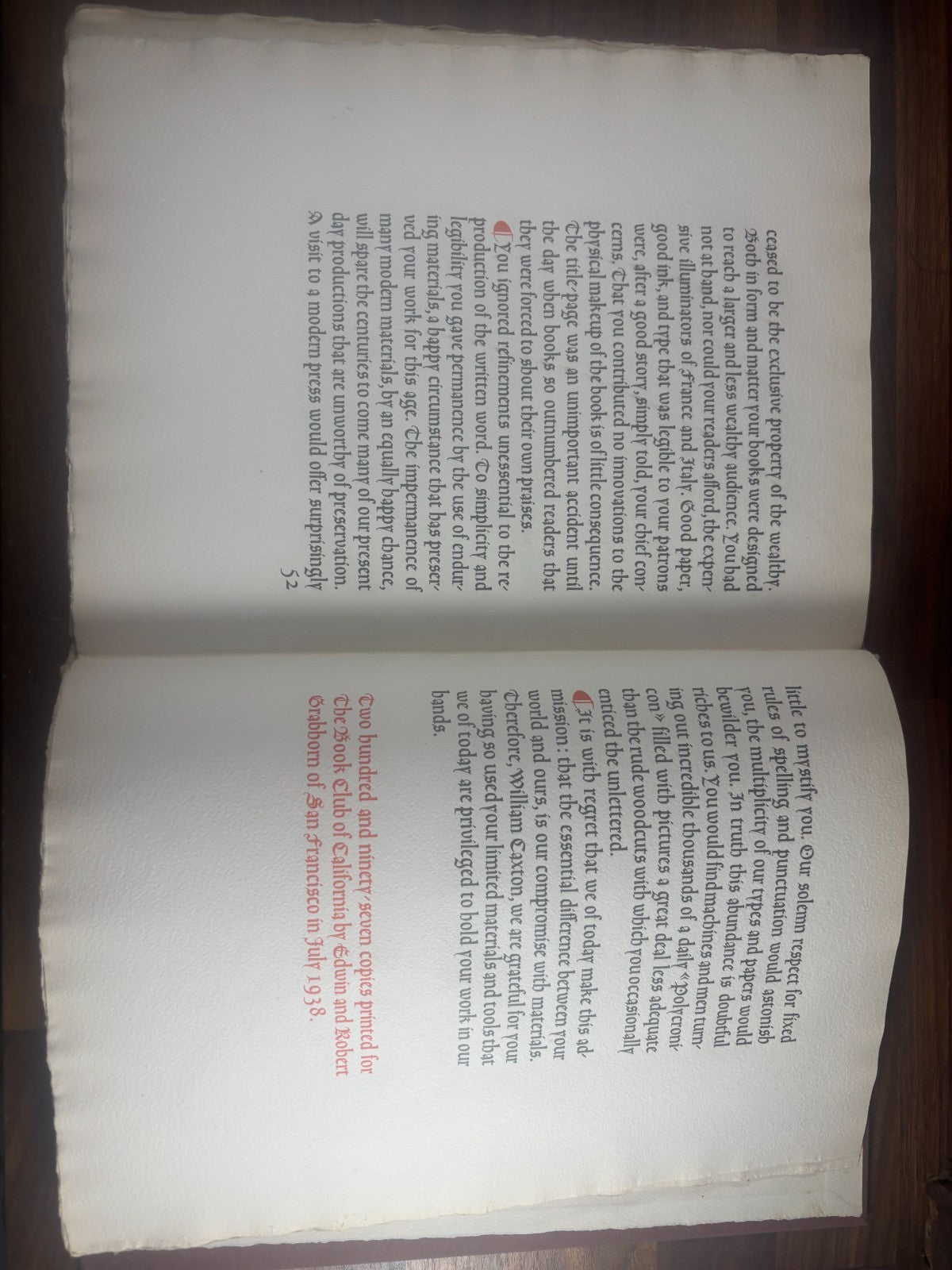
Binding: 20th-century fine press leaf book (Harold Hugo)
Offered here is an authentic 15th-century printed leaf from a book produced by William Caxton, England’s first printer. The leaf dates to approximately 1482 and comes from Caxton’s English printing of The Polycronicon, one of the most important historical works of the Middle Ages.
The original leaf is professionally mounted and housed within a custom 20th-century fine-press volume, created to preserve, explain, and honour the significance of early English printing.
This is a genuine incunable, not a facsimile or reproduction.
THE LEAF:
-
Original Caxton-printed leaf on handmade laid paper
-
Gothic blackletter type typical of Caxton’s Westminster press
-
Visible age toning, texture, and deckled edges consistent with 15th-century paper
-
Early hand rubrication - red initials/marks
The leaf is securely mounted on a guard and has not been trimmed or glued, allowing margins and paper character to remain visible.
ABOUT WILLIAM CAXTON:
William Caxton (c. 1422–1491) was the first person to introduce the printing press to England and is one of the most important figures in the history of English language and literature.
-
Established England’s first printing press at Westminster in the 1470s
-
Printed the first books in English
-
Helped standardize English spelling and literary culture
-
Printed works by Chaucer, Malory, Gower, and major historical chronicles
The Polycronicon was among Caxton’s most ambitious projects: a comprehensive world history translated into English, making historical knowledge accessible to a broader audience for the first time.
Original Caxton books are now almost entirely held by major institutions. Individual leaves are scarce, highly collectible, and historically significant.
ABOUT THE MOUNTING BOOK:
The Caxton leaf is preserved in a custom fine-press “leaf book”, produced in the mid-20th century by or for Harold Hugo, a noted American fine printer and book artist based in San Francisco.
This volume includes:
-
A fine-press printed title page describing the Caxton leaf
-
Scholarly explanatory text on Caxton and the Polycronicon
-
Handmade paper
-
Hand-set type with red and black ink
-
A restrained Arts & Crafts, style binding with cloth spine
ABOUT DR. MONROE (COMMISSIONER OF THE VOLUME):
The present volume was commissioned in 1938 by Dr. Monroe, a private collector and bibliophile with a scholarly interest in early printing and typographic history.
At the time, it was common for learned collectors—particularly physicians, academics, and antiquarians—to commission custom “leaf books” in order to preserve and study original incunable leaves that survived from damaged or incomplete early printed books. Dr. Monroe’s commission reflects this tradition of serious bibliophilic stewardship rather than casual collecting.
Under his direction, the Caxton leaf was:
-
Carefully mounted on a guard (not pasted down)
-
Surrounded by scholarly explanatory material
-
Bound in a restrained fine-press format suitable for long-term preservation
The handwritten notes within the volume, as well as the printed contextual material, are consistent with early-to-mid 20th century antiquarian scholarship and indicate that Dr. Monroe intended this not merely as a display object, but as a documented historical artefact.
The date of 1938 places the creation of this volume firmly within the golden age of American fine-press collecting, when early English printing, especially Caxton, was highly sought after by knowledgeable private collectors.
This type of presentation was intentionally created to:
-
Protect fragile medieval leaves
-
Provide historical and bibliographic context
-
Create a dignified, collectible object
Such bindings are valued by collectors and institutions and are considered an appropriate and desirable way to preserve dispersed incunable leaves.
Dimensions:
Weight - 575g
Height - 30cm
Width - 23.5cm
Thickness - 1.5cm
Share